Below is a link for everyone who wants to watch the latest Cosmic Disclosure episode for free, where Emery Smith and David Wilcock discuss how the US Military uses advanced technology to discover underground civilizations around the Earth, as well as an amazing use of this technology that will benefit humanity as a whole.
https://give.gaia.com/cjfx4tyfy000801myodkmuq7e
The transcript of this episode can also be found here:
https://spherebeingalliance.com/blog/transcript-cosmic-disclosure-confirming-underground-civilizations.html
Showing posts with label cosmic disclosure. Show all posts
Showing posts with label cosmic disclosure. Show all posts
Friday, April 13, 2018

Monday, June 19, 2017
[Cosmic Disclosure] Season 7, Episode 21: Zero Point Energy and Advanced Propulsion Technology
Below is the first part of the transcript for Episode 22 of Cosmic Disclosure, Season 7. In this episode, Corey Goode and David Wilcock discussed the testimonial of Mark McCandlish on various aspects of free energy, including how the US government is suppressing its development from public use, and on the other hand how it is used in advanced propulsion technology.
http://spherebeingalliance.com/blog/transcript-cosmic-disclosure-zero-point-energy-and-advanced-propulsion-technology.html
---------------------------------------------------------------------------------------
 David Wilcock: All right. Welcome back to “Cosmic Disclosure”. I'm your host, David Wilcock. So, Corey, welcome back.
Corey Goode: Thank you.
David: So I've got to say that when I saw this interview footage, the first one we're going to watch here, he actually mentions the name of a guy who I knew very well.
And Mark Comings is one of the only people I've ever met who literally could run rings around me when it came to advanced physics.
And so when you and I are talking, you know a lot more about Secret Space Program stuff than anybody else I've met, except for a few insiders.
Mark Comings is one of those guys, but in the physics arena. So this really shocked me to hear him mention that name because I know so much about this guy we could talk about him for two hours.
So without further ado, let's hear the first thing that Mark McCandlish has to say, and maybe you'll understand why I was so surprised once you see it yourself. Let's take a look.
* * * * * *
CHASING FREE ENERGY
Mark McCandlish: I met a scientist who has since sort of taken himself out of circulation. He's vanished. His name was Mark Comings.
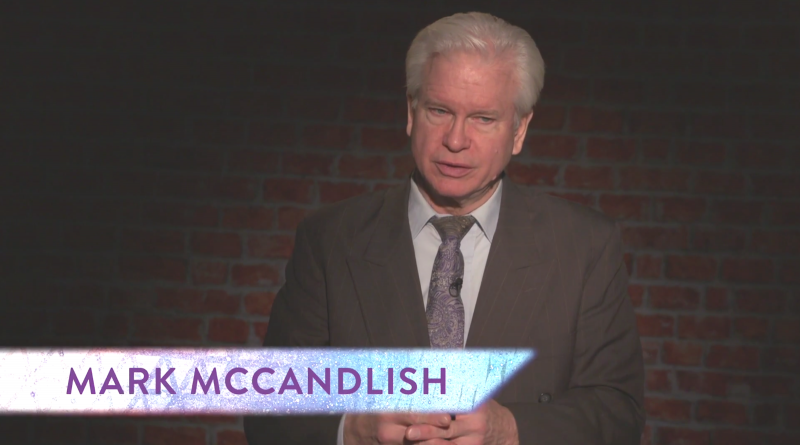
He was a physics professor working as a teaching assistant at UC Berkeley, in their physics department.
And he had been . . . He'd become aware of the fact that in the basement of the physics building on campus was a lot of this old surplus equipment – frequency generators and oscilloscopes and power generators – all these different kinds of things.
So he asked the head of the department if he could go down and just tinker and do some experiments. He had some ideas he wanted to play around with. And they gave him the okay.
So he had this idea that, as you may know, there are certain kinds of crystals, like quartz for example, that . . . It's the whole basis for the original phonograph record, the stylus.
When you would put a small crystal – I think it was like a diamond crystal – under pressure, it would create a mild electrical current. And if you amplify that current, you could then hear what the impulses were coming through that stone, that gem. And you could actually hear the vibrations that were recorded in a disk of plastic. That's how the phonograph works.
And so his idea was that, okay, crystals, when they're put under pressure – physical pressure – will create an electrical charge. But he wondered if you augmented the process by putting electrical coils that wrapped around the crystal, and you essentially applied an electrical pressure to the crystal, that the crystal would do not only the same piezoelectric process of creating an output of electricity, but that it might actually be more than what you would get with just putting physical pressure on it.
That by taking advantage of the lattice – the crystalline structure of this object, this stone – that you could then get it to resonate in a way that would kick out even more energy than you were putting into it.
And so he had a barium titanate crystal. It was about eight inches long, double terminated – in other words, a point on each side – had a cross-section that was kind of like a stop sign, sort of an octagon shape, had it fabricated by a facility outside the San Francisco Bay area where he lived.
And he had two different coils. One had a lot of fine windings, and another coil wrapped around the outside of that, all completely insulated, that had a lower number of windings.
And he experimented with putting a variety of different electrical charges, different voltages, frequencies, in different combinations, until eventually one night, about 1 o'clock in the morning, working late on this apparatus, the crystal began to glow a bluish-green, and it began to ring.
You know how when you're at a wedding, and you take your glass – your wet finger on a champagne glass, and it makes that high pitched ringing sound? He said it was like that.
And he looked at the scale – the dials on his equipment that showed input voltage and output voltage.
And this thing was putting out 125% more – in other words, everything it was getting plus an additional 25% over and above what he was putting into the crystal.
Of course, he was very excited, you know, took his notes, shut everything down, went home, went to bed. And by 8 o'clock the next morning, his house was surrounded by black SUVs and guys with ear buds and dark glasses.
They kick in the front door. They tossed the whole house. They arrested him. They confiscated all his notes. They confiscated his equipment.
And they basically said that they'd found a closed circuit TV system that he'd set up to view some of the women in the Phys Ed building, the locker room, the women's locker room in the next building. And, you know, he was in trouble.
And they wouldn't tell him what he was being charged with. They kept saying, “You know what you're charged with. You know what's going on here.”
And the reality of the whole thing was that he had created an apparatus that had accomplished what is supposedly impossible.
And I asked him, I said, “When you did this, when this thing finally worked when you found all of the right ingredients to make it work, do you believe that this thing put out some kind of a footprint in the environment that someone in the know was listening for and were ready to clamp down on?”
He said, “Absolutely, without a question.” He said, “Somebody triangulated my position, found out where I was, found the equipment, got ahold of the administration of the university, and they were at my house by 8 o'clock the next morning.”
That's how fast it was. And so he's gone into hiding. And I've heard that he's working somewhere in the Far East.
He's well-funded and continues his research, but all underground.
* * * * * *
David: Well, Corey, this is a very emotional thing for me actually, because first of all, I knew Mark Comings before he went into hiding. We actually spoke on the same stage at a conference I was doing in Portland in 2003, called “Time and Global Shift”.
And he wouldn't tell me what he had invented that caused these guys to come to his house. So seeing McCandlish go into detail about what the invention was was a first. I had not heard . . . I just heard about the bad parts.
So let's talk about that first. Is there, in fact, some sort of energetic signature like Mark and I also talked about personally, that we theorized had been released when you build one of these types of devices that they could detect?
Corey: Yes. And that is how they track, also, a lot of the nonterrestrial and human craft within our solar system.
It is used as a way of doing air traffic control to be able to locate the vessels producing this signature. There is indeed a signature that is put off in a limited spectrum that they are always listening for on the Earth and also in space.
David: Is there any place safe in the world for somebody to develop this technology? Or could the Cabal hit you basically at any geographical location on Earth?
Corey: When it comes to developing it, yeah, there are plenty of deep, dark holes you can hide in to develop it. And you have to acquire everything that you're going to use – all of the different types of technology – you have to acquire it very quietly.
If one person starts acquiring certain technology, red flags go off.
So you can find a place secure to develop it, but the minute you're successful, they're going to know because of this energy signature that they can pick up.
David: Right.
Corey: That's why they watch these people very closely, very important that they develop a personality profile on them so they can decide which way to approach them.
Some people, you know, the almighty dollar. If they go and offer them $1 billion, they'll sign over the patent very quickly.
Others, who are more principled, they have to threaten their families. They have to lean on them. And sometimes, ultimately, these people will die of strange cancers, heart attacks, strokes, suicide.
David: It sounds like you're describing a different type of what John Perkins wrote about in his classic book, “Confessions of an Economic Hitman”. And he called it “The gun or the money campaign” . . .
Corey: Um-hmm.
David: . . . where he'd walk in with a gun in one hand and a bale of cash in the other, and say, “I'm giving you one of the two of these before I leave here. Which one do you want?”
Corey: Yes.
David: Same basic idea, huh?
Corey: Same basic idea. And, I mean, if it's going to work in that situation, humans are so much the same, they're going to be able to use it for the free energy sector as well.
David: Another story that Mark Comings told me was that in another group that was aware of this kind of thing happening, they tried to build a free energy device where each component was built separately and the plans were kept separate.
And then only right when they were going to test it would they have each of the guys bring a different piece of the machine together, build it on the spot, test it, then break it down and take it away.
But even in that situation, he said they still got popped.
Corey: Well, it's easy because there are satellites that are covering almost every square inch of . . . well, every square inch that is important on the Earth.
So if they came together real quick, put this device together, turned it on, and then The-Powers-That-Be got this signal ping on their device – they call it a ping – and then these people take apart the device and then scoot, well, they're going to be able to go and rewind – just like a videotape where this satellite was tasked, at what time – and go to the right satellite, find the footage, and then track the people back to where they came from.
David: It's very interesting that Mark Comings is describing the crystal glowing. So I'm curious if you ever witnessed glowing crystal technology in any of the stuff that you saw.
Corey: I saw the scientists working with different types of crystals and stones and stuff, and I saw very small crystals that were square, obviously man made, glow when a field was applied to them.
And there were . . . Nothing physically was touching them. So, yeah, I've seen that.
David: If they give you, let's say, billions of dollars, and you take it. Do they then kill you later, or do you actually get to live out your life?
Corey: Very quietly live your life, probably on a remote island.
David: All right. Well, with that in mind, let's now see this next piece of interview footage with Mark McCandlish discussing the interesting and scary politics of free energy. Take a look.
(Continue reading here)
http://spherebeingalliance.com/blog/transcript-cosmic-disclosure-zero-point-energy-and-advanced-propulsion-technology.html
---------------------------------------------------------------------------------------
Corey Goode: Thank you.
David: So I've got to say that when I saw this interview footage, the first one we're going to watch here, he actually mentions the name of a guy who I knew very well.
And Mark Comings is one of the only people I've ever met who literally could run rings around me when it came to advanced physics.
And so when you and I are talking, you know a lot more about Secret Space Program stuff than anybody else I've met, except for a few insiders.
Mark Comings is one of those guys, but in the physics arena. So this really shocked me to hear him mention that name because I know so much about this guy we could talk about him for two hours.
So without further ado, let's hear the first thing that Mark McCandlish has to say, and maybe you'll understand why I was so surprised once you see it yourself. Let's take a look.
* * * * * *
CHASING FREE ENERGY
Mark McCandlish: I met a scientist who has since sort of taken himself out of circulation. He's vanished. His name was Mark Comings.
He was a physics professor working as a teaching assistant at UC Berkeley, in their physics department.
And he had been . . . He'd become aware of the fact that in the basement of the physics building on campus was a lot of this old surplus equipment – frequency generators and oscilloscopes and power generators – all these different kinds of things.
So he asked the head of the department if he could go down and just tinker and do some experiments. He had some ideas he wanted to play around with. And they gave him the okay.
So he had this idea that, as you may know, there are certain kinds of crystals, like quartz for example, that . . . It's the whole basis for the original phonograph record, the stylus.
When you would put a small crystal – I think it was like a diamond crystal – under pressure, it would create a mild electrical current. And if you amplify that current, you could then hear what the impulses were coming through that stone, that gem. And you could actually hear the vibrations that were recorded in a disk of plastic. That's how the phonograph works.
And so his idea was that, okay, crystals, when they're put under pressure – physical pressure – will create an electrical charge. But he wondered if you augmented the process by putting electrical coils that wrapped around the crystal, and you essentially applied an electrical pressure to the crystal, that the crystal would do not only the same piezoelectric process of creating an output of electricity, but that it might actually be more than what you would get with just putting physical pressure on it.
That by taking advantage of the lattice – the crystalline structure of this object, this stone – that you could then get it to resonate in a way that would kick out even more energy than you were putting into it.
And so he had a barium titanate crystal. It was about eight inches long, double terminated – in other words, a point on each side – had a cross-section that was kind of like a stop sign, sort of an octagon shape, had it fabricated by a facility outside the San Francisco Bay area where he lived.
And he had two different coils. One had a lot of fine windings, and another coil wrapped around the outside of that, all completely insulated, that had a lower number of windings.
And he experimented with putting a variety of different electrical charges, different voltages, frequencies, in different combinations, until eventually one night, about 1 o'clock in the morning, working late on this apparatus, the crystal began to glow a bluish-green, and it began to ring.
You know how when you're at a wedding, and you take your glass – your wet finger on a champagne glass, and it makes that high pitched ringing sound? He said it was like that.
And he looked at the scale – the dials on his equipment that showed input voltage and output voltage.
And this thing was putting out 125% more – in other words, everything it was getting plus an additional 25% over and above what he was putting into the crystal.
Of course, he was very excited, you know, took his notes, shut everything down, went home, went to bed. And by 8 o'clock the next morning, his house was surrounded by black SUVs and guys with ear buds and dark glasses.
They kick in the front door. They tossed the whole house. They arrested him. They confiscated all his notes. They confiscated his equipment.
And they basically said that they'd found a closed circuit TV system that he'd set up to view some of the women in the Phys Ed building, the locker room, the women's locker room in the next building. And, you know, he was in trouble.
And they wouldn't tell him what he was being charged with. They kept saying, “You know what you're charged with. You know what's going on here.”
And the reality of the whole thing was that he had created an apparatus that had accomplished what is supposedly impossible.
And I asked him, I said, “When you did this, when this thing finally worked when you found all of the right ingredients to make it work, do you believe that this thing put out some kind of a footprint in the environment that someone in the know was listening for and were ready to clamp down on?”
He said, “Absolutely, without a question.” He said, “Somebody triangulated my position, found out where I was, found the equipment, got ahold of the administration of the university, and they were at my house by 8 o'clock the next morning.”
That's how fast it was. And so he's gone into hiding. And I've heard that he's working somewhere in the Far East.
He's well-funded and continues his research, but all underground.
* * * * * *
David: Well, Corey, this is a very emotional thing for me actually, because first of all, I knew Mark Comings before he went into hiding. We actually spoke on the same stage at a conference I was doing in Portland in 2003, called “Time and Global Shift”.
And he wouldn't tell me what he had invented that caused these guys to come to his house. So seeing McCandlish go into detail about what the invention was was a first. I had not heard . . . I just heard about the bad parts.
So let's talk about that first. Is there, in fact, some sort of energetic signature like Mark and I also talked about personally, that we theorized had been released when you build one of these types of devices that they could detect?
Corey: Yes. And that is how they track, also, a lot of the nonterrestrial and human craft within our solar system.
It is used as a way of doing air traffic control to be able to locate the vessels producing this signature. There is indeed a signature that is put off in a limited spectrum that they are always listening for on the Earth and also in space.
David: Is there any place safe in the world for somebody to develop this technology? Or could the Cabal hit you basically at any geographical location on Earth?
Corey: When it comes to developing it, yeah, there are plenty of deep, dark holes you can hide in to develop it. And you have to acquire everything that you're going to use – all of the different types of technology – you have to acquire it very quietly.
If one person starts acquiring certain technology, red flags go off.
So you can find a place secure to develop it, but the minute you're successful, they're going to know because of this energy signature that they can pick up.
David: Right.
Corey: That's why they watch these people very closely, very important that they develop a personality profile on them so they can decide which way to approach them.
Some people, you know, the almighty dollar. If they go and offer them $1 billion, they'll sign over the patent very quickly.
Others, who are more principled, they have to threaten their families. They have to lean on them. And sometimes, ultimately, these people will die of strange cancers, heart attacks, strokes, suicide.
David: It sounds like you're describing a different type of what John Perkins wrote about in his classic book, “Confessions of an Economic Hitman”. And he called it “The gun or the money campaign” . . .
Corey: Um-hmm.
David: . . . where he'd walk in with a gun in one hand and a bale of cash in the other, and say, “I'm giving you one of the two of these before I leave here. Which one do you want?”
Corey: Yes.
David: Same basic idea, huh?
Corey: Same basic idea. And, I mean, if it's going to work in that situation, humans are so much the same, they're going to be able to use it for the free energy sector as well.
David: Another story that Mark Comings told me was that in another group that was aware of this kind of thing happening, they tried to build a free energy device where each component was built separately and the plans were kept separate.
And then only right when they were going to test it would they have each of the guys bring a different piece of the machine together, build it on the spot, test it, then break it down and take it away.
But even in that situation, he said they still got popped.
Corey: Well, it's easy because there are satellites that are covering almost every square inch of . . . well, every square inch that is important on the Earth.
So if they came together real quick, put this device together, turned it on, and then The-Powers-That-Be got this signal ping on their device – they call it a ping – and then these people take apart the device and then scoot, well, they're going to be able to go and rewind – just like a videotape where this satellite was tasked, at what time – and go to the right satellite, find the footage, and then track the people back to where they came from.
David: It's very interesting that Mark Comings is describing the crystal glowing. So I'm curious if you ever witnessed glowing crystal technology in any of the stuff that you saw.
Corey: I saw the scientists working with different types of crystals and stones and stuff, and I saw very small crystals that were square, obviously man made, glow when a field was applied to them.
And there were . . . Nothing physically was touching them. So, yeah, I've seen that.
David: If they give you, let's say, billions of dollars, and you take it. Do they then kill you later, or do you actually get to live out your life?
Corey: Very quietly live your life, probably on a remote island.
David: All right. Well, with that in mind, let's now see this next piece of interview footage with Mark McCandlish discussing the interesting and scary politics of free energy. Take a look.
(Continue reading here)
Saturday, June 03, 2017
Short update from Corey Goode on Facebook
Below is a short update from Corey Goode on his Sphere Alliance Beings Facebook page, which is about a major incidents when an insider was being attacked.
Please send light and positive energy to Corey Goode and this insider to give them energetic protection.
https://www.facebook.com/BlueAvians/posts/1757314887899633
----------------------------------------------------
We have had some major incidents occur while here in Boulder to shoot Cosmic Disclosure. A move was made against one of our insiders that is in line with the Coordinated Agency Attacks that have been going on since we disclosed the "Antarctic Atlantis". For now, I have to keep the details confidential. We will be sharing more info about this incident soon. We are seeing signs of desperation from the Cabal. This move against a close insider as well as the Agencies "blowing their wad" and activating all of their assets in the Ufology Community shows how desperate and near collapse the Cabal is. One good thing, all agents and negative actors in this field have self identified! They can't put that back in the box, though they will try. Stand by... Much more information to come.. Send us some positive energy, we are under attack from all directions by the opposition. CG
Please send light and positive energy to Corey Goode and this insider to give them energetic protection.
https://www.facebook.com/BlueAvians/posts/1757314887899633
----------------------------------------------------
We have had some major incidents occur while here in Boulder to shoot Cosmic Disclosure. A move was made against one of our insiders that is in line with the Coordinated Agency Attacks that have been going on since we disclosed the "Antarctic Atlantis". For now, I have to keep the details confidential. We will be sharing more info about this incident soon. We are seeing signs of desperation from the Cabal. This move against a close insider as well as the Agencies "blowing their wad" and activating all of their assets in the Ufology Community shows how desperate and near collapse the Cabal is. One good thing, all agents and negative actors in this field have self identified! They can't put that back in the box, though they will try. Stand by... Much more information to come.. Send us some positive energy, we are under attack from all directions by the opposition. CG
Thursday, June 01, 2017
[Cosmic Disclosure] Season 7, Episode 21: Boyd Bushman's Deathbed Testimonial
Below is the first part of the transcript for Episode 21 of Cosmic Disclosure, Season 7. In this episode, Corey Goode and David Wilcock discussed about a very famous video clip of Boyd Bushman, in which he shows a number of photos of an extra-terrestrial being "The Oranges" before his death.
Corey also added a lot more information on this type of ET in the later part of this episode.
There seems to be a lot of copies of this video on YouTube. Here is the one which I believe has the most views.
https://www.youtube.com/watch?v=VA3HV_gfq80&t=4s
Source: http://spherebeingalliance.com/blog/transcript-cosmic-disclosure-boyd-bushmans-deathbed-testimonial.html
---------------------------------------------------------------
David Wilcock: All right. Welcome to “Cosmic Disclosure”. I'm your host, David Wilcock. I'm here with Corey Goode, our insider's insider. And in this episode, we have some rare footage from a now deceased insider from Lockheed Martin, none other than Boyd Bushman.
So, Corey, welcome to the show.
Corey Goode: Thank you.
David: All right. So here's our first excerpt of an interview that we did not shoot with Boyd Bushman, but is public domain, fair use on the Internet. And given the importance and what we talk about on this show, it's well worth watching. Let's check it out.
* * * * * *
MEET BOYD
Boyd Bushman: My name is Boyd Bushman. I'm a senior scientist from Lockheed Martin. I have 27 patents.
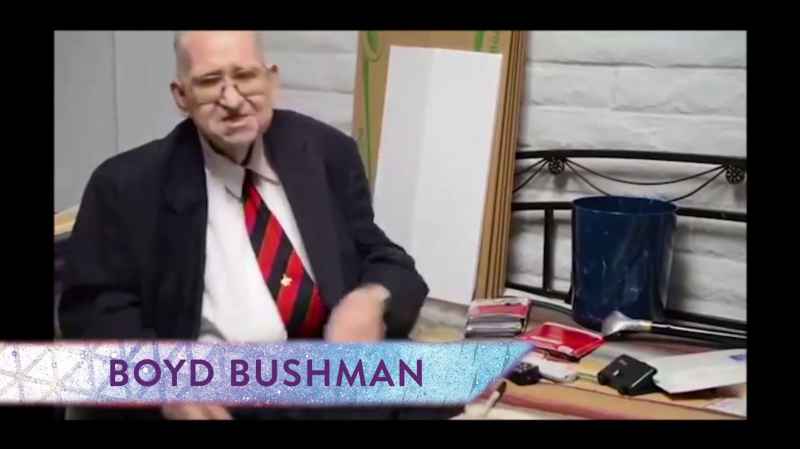
Approximately 13 years ago, I ran across a person who had been given a job by Dr. Teller.
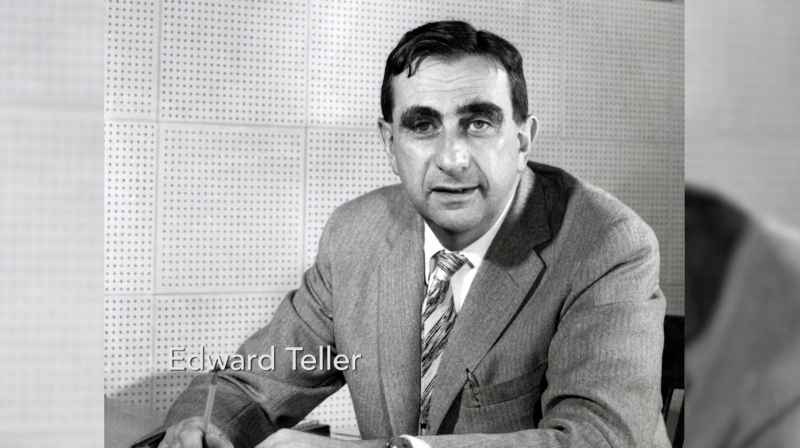
Dr. Teller was Oppenheimer's right-hand man.

And even after Oppenheimer was thrown out of Area 51, Dr. Teller stayed there and was in charge of several programs.
The person that I contact twice to three times per month is the head of that program now, and they continually update me on everything they possibly can. I do have a top secret clearance.
I choose, however, for their purposes, not to use it because they – the intelligent ones of me and me – actually believe that a great deal of information should be lifted up from those dark recesses of Area 51 and moved over so people can see it.
So that's what began about 13 years ago.
Since I am a scientist, I do not believe in theory. I basically, say, “Follow the data; theory be damned.” If something can't verify by a physical test that something is true, then I do not care to accept it in that [information] that I present.
Therefore, everything we present here will be data that comes directly from them, through me, to you.
* * * * * *
David: He's talking about the idea that Teller was working with a group of insiders and that they now want to disclose the truth. So is this something that happens fairly often in these classified programs, that people actually do want to get the information out?
Corey: Yes, it's fairly common. And whoever is doing security of these groups know that. They've done personality profiles on these people. They watch them very closely. They're watching for body language, different micro facial expressions. They're watching them very closely to know whether they need to step in.
So a lot of the times, these guys will usually have these conversations, you know, at a Sunday cookout and sit around and talk about it instead of talking about it at work.
And eventually, they end up getting found out, for the most part. It's very rare that they don't find out that they're talking about it “outside of the office”, as they say.
David: He said in there, “I have a top secret clearance, but I don't choose to use it.” What do you think he meant by that?
Corey: If you go in and work under a top security clearance, you're bound, legally, by everything you agreed to when you signed the agreement for the security clearance.
So if he's trying to work, he's trying to skirt the security clearance and any retributions that may happen legally or with his pension. So he's playing kind of a little game.
David: Now, when this interview came out, as I'm sure you remember, it lit up even the mainstream media like a wildfire. There were a lot of articles that were written about this, covering this guy.
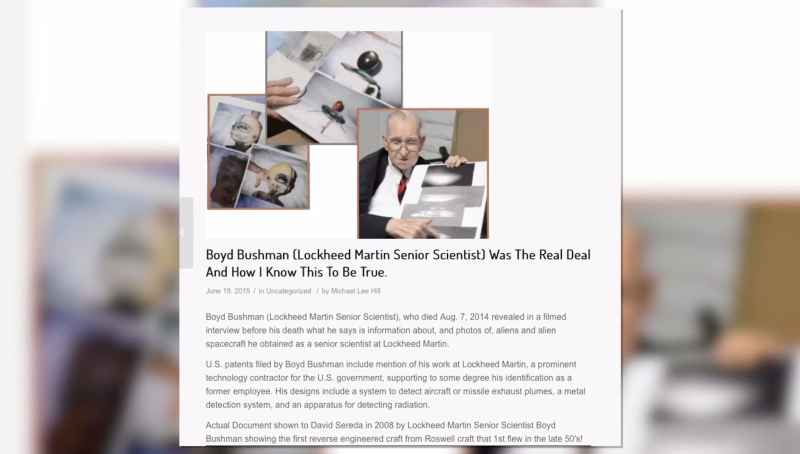
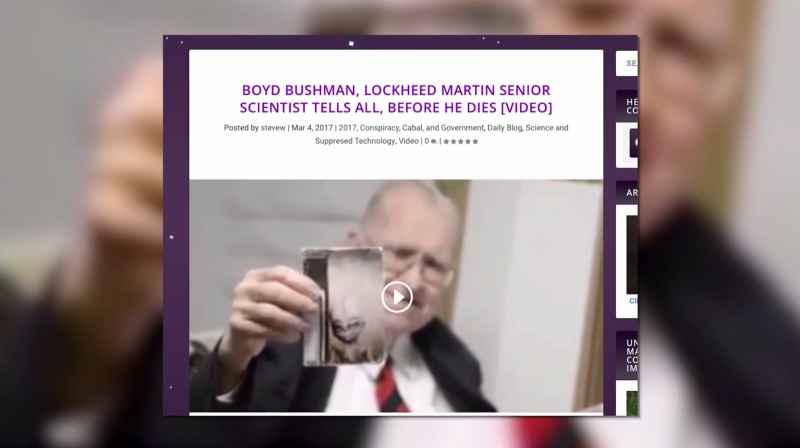
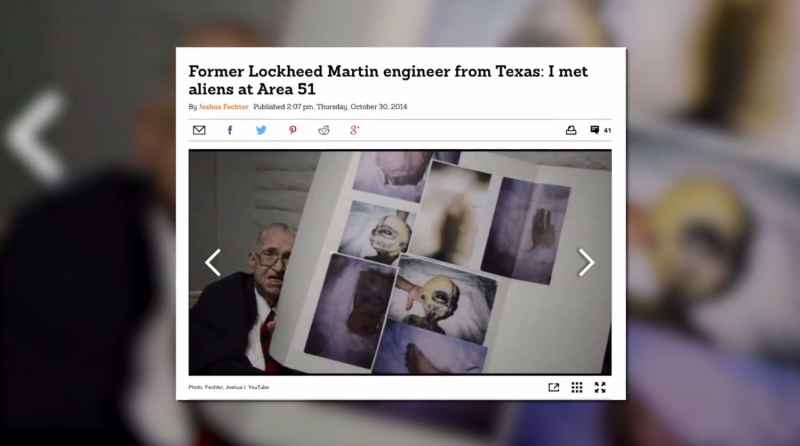
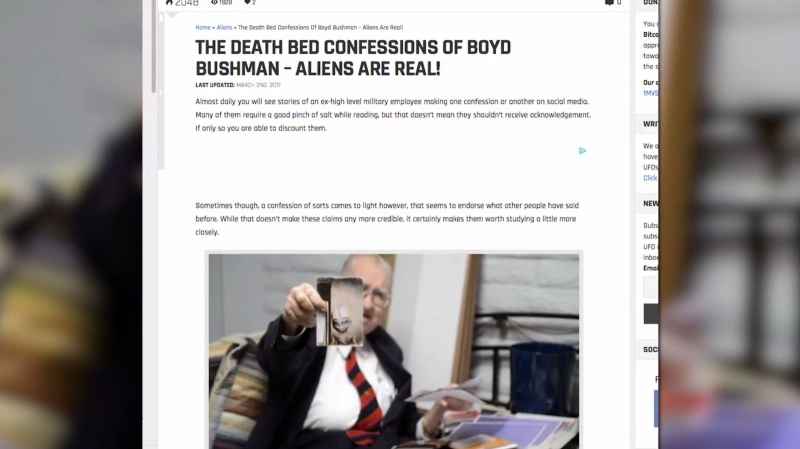
So that, to me, suggests that he is not working as some rogue, but that what he's doing here was perhaps part of an orchestrated plan. Do you think that's true?
Corey: Well, it very well could be, because the groups that I was describing prior, the ones that don't get caught, are the ones that find like-minded people in security that turn a blind eye to the talk.
These are the types of people that really got this SSP Alliance rolling.
David: Right.
Corey: You know? That's how it got rolling.
David: What would be the objective of articles about this man and what he's going to say as we go through this episode, being released to the public?
He does seem to have the credibility. He says he works for Lockheed. We're going to see some pictures of extraterrestrials, allegedly.
What would be the ultimate endgame of promoting these videos and his testimony in front of the whole world?
Corey: Well, the Alliance anyway, and as well as the – whoever we want to name – the shadow government, they've been seeding the consciousness of humanity through movies and, you know, comic books, people giving deathbed statements like this.
So they kind of want to – in a way that they can distance themselves from or deny – deliver this information in bits and pieces to our subconscious.
David: He said that he worked for Lockheed, and he has 27 patents.
Corey: That should be easy to verify, unless they're . . .
David: That's what I'm thinking.
Corey: . . . one of the 5,700 classified patents.
(Continue reading here)
Corey also added a lot more information on this type of ET in the later part of this episode.
There seems to be a lot of copies of this video on YouTube. Here is the one which I believe has the most views.
https://www.youtube.com/watch?v=VA3HV_gfq80&t=4s
Source: http://spherebeingalliance.com/blog/transcript-cosmic-disclosure-boyd-bushmans-deathbed-testimonial.html
---------------------------------------------------------------
David Wilcock: All right. Welcome to “Cosmic Disclosure”. I'm your host, David Wilcock. I'm here with Corey Goode, our insider's insider. And in this episode, we have some rare footage from a now deceased insider from Lockheed Martin, none other than Boyd Bushman.
So, Corey, welcome to the show.
Corey Goode: Thank you.
David: All right. So here's our first excerpt of an interview that we did not shoot with Boyd Bushman, but is public domain, fair use on the Internet. And given the importance and what we talk about on this show, it's well worth watching. Let's check it out.
* * * * * *
MEET BOYD
Boyd Bushman: My name is Boyd Bushman. I'm a senior scientist from Lockheed Martin. I have 27 patents.
Approximately 13 years ago, I ran across a person who had been given a job by Dr. Teller.
Dr. Teller was Oppenheimer's right-hand man.
And even after Oppenheimer was thrown out of Area 51, Dr. Teller stayed there and was in charge of several programs.
The person that I contact twice to three times per month is the head of that program now, and they continually update me on everything they possibly can. I do have a top secret clearance.
I choose, however, for their purposes, not to use it because they – the intelligent ones of me and me – actually believe that a great deal of information should be lifted up from those dark recesses of Area 51 and moved over so people can see it.
So that's what began about 13 years ago.
Since I am a scientist, I do not believe in theory. I basically, say, “Follow the data; theory be damned.” If something can't verify by a physical test that something is true, then I do not care to accept it in that [information] that I present.
Therefore, everything we present here will be data that comes directly from them, through me, to you.
* * * * * *
David: He's talking about the idea that Teller was working with a group of insiders and that they now want to disclose the truth. So is this something that happens fairly often in these classified programs, that people actually do want to get the information out?
Corey: Yes, it's fairly common. And whoever is doing security of these groups know that. They've done personality profiles on these people. They watch them very closely. They're watching for body language, different micro facial expressions. They're watching them very closely to know whether they need to step in.
So a lot of the times, these guys will usually have these conversations, you know, at a Sunday cookout and sit around and talk about it instead of talking about it at work.
And eventually, they end up getting found out, for the most part. It's very rare that they don't find out that they're talking about it “outside of the office”, as they say.
David: He said in there, “I have a top secret clearance, but I don't choose to use it.” What do you think he meant by that?
Corey: If you go in and work under a top security clearance, you're bound, legally, by everything you agreed to when you signed the agreement for the security clearance.
So if he's trying to work, he's trying to skirt the security clearance and any retributions that may happen legally or with his pension. So he's playing kind of a little game.
David: Now, when this interview came out, as I'm sure you remember, it lit up even the mainstream media like a wildfire. There were a lot of articles that were written about this, covering this guy.
So that, to me, suggests that he is not working as some rogue, but that what he's doing here was perhaps part of an orchestrated plan. Do you think that's true?
Corey: Well, it very well could be, because the groups that I was describing prior, the ones that don't get caught, are the ones that find like-minded people in security that turn a blind eye to the talk.
These are the types of people that really got this SSP Alliance rolling.
David: Right.
Corey: You know? That's how it got rolling.
David: What would be the objective of articles about this man and what he's going to say as we go through this episode, being released to the public?
He does seem to have the credibility. He says he works for Lockheed. We're going to see some pictures of extraterrestrials, allegedly.
What would be the ultimate endgame of promoting these videos and his testimony in front of the whole world?
Corey: Well, the Alliance anyway, and as well as the – whoever we want to name – the shadow government, they've been seeding the consciousness of humanity through movies and, you know, comic books, people giving deathbed statements like this.
So they kind of want to – in a way that they can distance themselves from or deny – deliver this information in bits and pieces to our subconscious.
David: He said that he worked for Lockheed, and he has 27 patents.
Corey: That should be easy to verify, unless they're . . .
David: That's what I'm thinking.
Corey: . . . one of the 5,700 classified patents.
(Continue reading here)
Monday, May 29, 2017
[Cosmic Disclosure] Season 7, Episode 20: Faster Than Light Technology with Mark McCandlish
Below is the first part of the transcript for Episode 20 of Cosmic Disclosure, Season 7. In this episode, a special guest Mark McCandlish shared an advanced craft that his insider friends saw by accident back in 1988, with detailed design graphs about how the craft achieve anti-gravity and speed of light.
Japanese translation of this transcript can be found here:
http://prepareforchange-japan.blogspot.co.uk/2017/05/CosmicDisclosure-720.html
Source: http://spherebeingalliance.com/blog/transcript-cosmic-disclosure-faster-than-light-technology-with-mark-mccandlish.html
-------------------------------------------------------------
David Wilcock: All right. Welcome back to “Cosmic Disclosure”. I'm your host, David Wilcock. I'm here with Corey Goode. So, Corey, welcome back to the show.
Corey Goode: Thank you.
David: We're going to start out now with the first of a series of interview footages from Mark McCandlish, where he's going to be talking about a particular type of propulsion system and a particular craft that one of his insider friends saw.
So without further ado, let's take a look.
* * * * * *
A TOUR OF HIDDEN TECHNOLOGY
Mark McCandlish: I get a phone call from a friend of mine that I'd known in college. For the sake of this conversation, I'll call him Brad.
So Brad calls up, and he says, “You know, I saw your article. I saw your art work, saw your name in the magazine, got a hold of the art director. He gave me your number, and this is Brad. Do you remember me?”
And I said, “Yeah. That's great.”
So we got together for lunch. We were talking, and I mentioned to him that there was an air show coming up at Norton Air Force Base, which is in San Bernardino. It's about 75 miles east of Los Angeles.
And there was a story that they might have the SR-71 Blackbird either do a flyby or that it might be on static display, which was kind of rare back then.
So we decide we were going to go to the air show. And at the last minute, the magazine called up and indicated that they were so happy with that illustration that they wanted me to do another illustration that was going to be coming out the following year in February of '89, on the X-31 program.
So they wanted it completed as a quick turnaround, and so I basically had to pass on going to the air show.
So about a week goes by, and I didn't hear anything from Brad. And I called him up, and I asked him, “Well, how did you like the air show?” But on the phone, he was very quiet.
And I said, “Well, what's wrong? You don't sound like you had a very good time at all.”
He said, “Well, I think I saw some things I wasn't supposed to see.”
And I said, “Well, how can that be? Everything that's at the air show is put there for static display for the public.”
And he says, “Well, there was another little show that happened while we were there.”
And in the beginning of this story, when this first came to me, he made it sound as though the exhibit that he was allowed to go into, the person that he had brought along, someone that we were going to network some illustration jobs for, was a high-ranking person at Lockheed Martin, and that they were going to . . . we were going to get together and talk about doing some work.
And this individual, right about the time the Thunderbird, the Air Force demonstration team, was about to start their program, he says to my friend, “Let's go over here.”
So this gentleman, my friend, a number of high-ranking politicians and high-ranking military brass, all boarded a Boeing 727, military airliner – military aircraft with passenger seats and so forth. And they departed from Norton and flew up to Air Force Plant 42, which is in Palmdale. That's where Lockheed Skunk Works is located.
So the plane rolls out. They get out of the plane, and the security detail that was around the building with a cordon and M16s, and the whole nine yards, challenged my friend because he didn't have any kind of a badge or anything like his escort did.
And so his escort essentially vouched for him, saying that he was this gentleman's aide.
So they go into the show, and as soon as they walk in, he looks around and he says, “Okay. I can see that there's some things here that I wasn't told about, things that you're not cleared to know about. So just keep your mouth shut. Don't say anything. Don't talk to anybody. We'll get out of here as soon as we can., but enjoy the show.”
So Brad indicated to me that there were high-ranking Air Force officers that were walking around like tour guides, and they were showing the various aircraft types that were on display, one of which was the first generation Aurora aircraft, what the Lockheed folks called the Pulser.
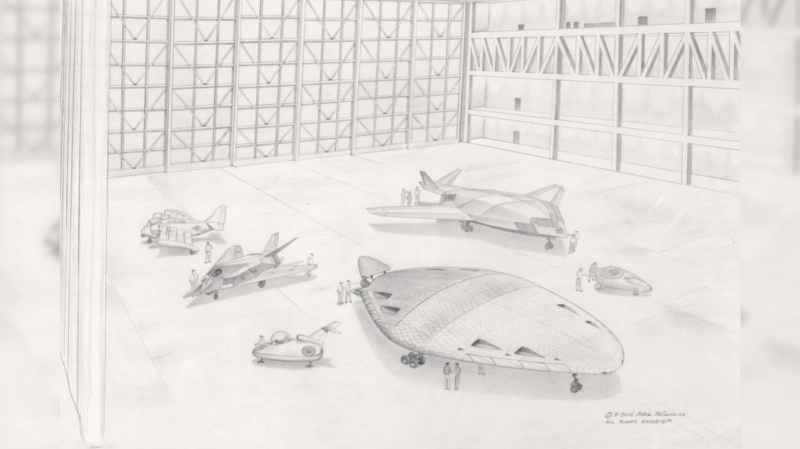
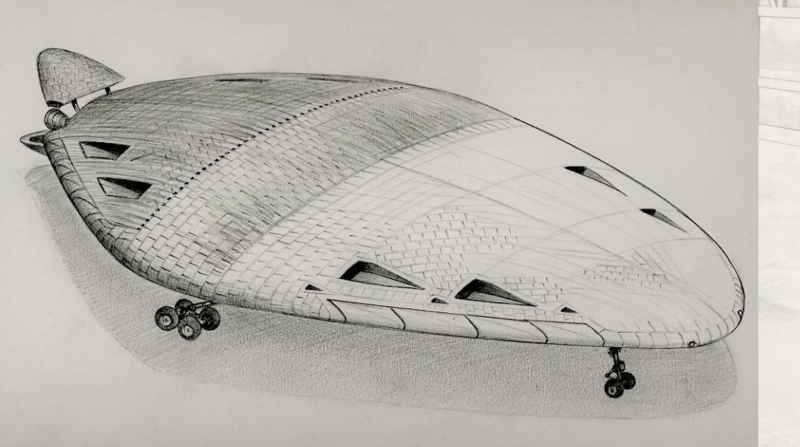
And so they had four engines that were buried in the airframe. The entire thing was covered with heat-ablative tiles, just like the Space Shuttle.
The back end of the aircraft was being used in the same way as . . . very much like the entire back end of the aircraft was like a linear aerospike engine with dozens of these fuel ejectors that would spray fuel into this supersonic shock wave and would spontaneously combust.
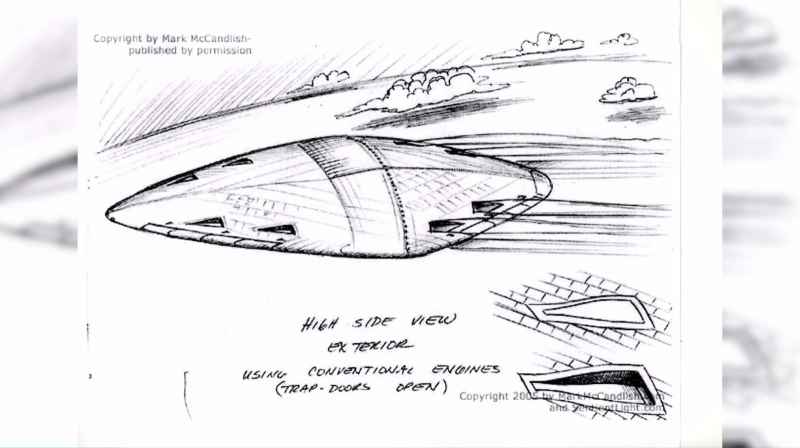
And the explosion of these gases would expand between the supersonic shock wave and the tapered afterbody of the aircraft and essentially pinch it – just like squeezing a wet pumpkin seed and having it shoot away out of your hands.
But the interesting thing about this particular aircraft type was that it obviously had some strategic applications, that it wasn't just for high-speed, high-altitude reconnaissance.
This was an aircraft that had weapons. And underneath the fuselage, buried in the fuselage between the engines, were 121 vertical launch tubes, each of which had a large circular heat-ablative tile on the outside that could be blown away with explosive bolts.
And what was so fascinating about this design was they kept it as simple as possible, but it was totally effective.
And they had what amounted to . . . that you could use either conventional explosive-type warhead, but they were in re-entry vehicles like the MIRVs that you see on an ICBM, except that above this MIRV in the tube, they had another heat-ablative tile with a big coiled spring behind it, all compressed.
And so as soon as they blew away the outer tile, this thing would be spit out of the tube. Another tile would come down, slam into place, and immediately restore the aerodynamic efficiency of the aircraft.
So you didn't have bomb bay doors and this kind of thing opening up when you're going at high speed.
Another one of the things that I found from recent disclosures was that when the aircraft was actually in the active functioning as a weapons platform, that it had a tertiary, a third type, of propulsion system where the back end, which was kind of flat but triangular shaped, it would open up.
It was like a clam shell on the back end, and a rocket motor would pop out, and this thing could then climb up into an exo-atmospheric launch position and loiter almost indefinitely.
This was probably one of the largest remotely-operated vehicles that's ever been in the inventory. But it did have a provision for being piloted by someone internally. But mostly, it was an unmanned aircraft.
But it could go up, and it could deploy these MIRV-type weapons from space.
* * * * * *
David: Well, for me, Corey, as an outsider who has not been in these circuits, when somebody comes forward and has this much technical detail, I'm extremely, extremely fascinated.
I've heard about the Aurora for so many years. Never have I heard the kind of detail that he just gave here.
What are your own thoughts in light of what we just saw?
Corey: Yeah, it's the amount of detail. That's what I was going to comment on.
The people that come out and talk about these things have normally just had a glimpse of them. They haven't had someone that was able to walk around and kick the tires and have a tour from Air Force personnel.
So this is very good insight on the way this craft works.
(Continue reading here)
Japanese translation of this transcript can be found here:
http://prepareforchange-japan.blogspot.co.uk/2017/05/CosmicDisclosure-720.html
Source: http://spherebeingalliance.com/blog/transcript-cosmic-disclosure-faster-than-light-technology-with-mark-mccandlish.html
-------------------------------------------------------------
David Wilcock: All right. Welcome back to “Cosmic Disclosure”. I'm your host, David Wilcock. I'm here with Corey Goode. So, Corey, welcome back to the show.
Corey Goode: Thank you.
David: We're going to start out now with the first of a series of interview footages from Mark McCandlish, where he's going to be talking about a particular type of propulsion system and a particular craft that one of his insider friends saw.
So without further ado, let's take a look.
* * * * * *
A TOUR OF HIDDEN TECHNOLOGY
Mark McCandlish: I get a phone call from a friend of mine that I'd known in college. For the sake of this conversation, I'll call him Brad.
So Brad calls up, and he says, “You know, I saw your article. I saw your art work, saw your name in the magazine, got a hold of the art director. He gave me your number, and this is Brad. Do you remember me?”
And I said, “Yeah. That's great.”
So we got together for lunch. We were talking, and I mentioned to him that there was an air show coming up at Norton Air Force Base, which is in San Bernardino. It's about 75 miles east of Los Angeles.
And there was a story that they might have the SR-71 Blackbird either do a flyby or that it might be on static display, which was kind of rare back then.
So we decide we were going to go to the air show. And at the last minute, the magazine called up and indicated that they were so happy with that illustration that they wanted me to do another illustration that was going to be coming out the following year in February of '89, on the X-31 program.
So they wanted it completed as a quick turnaround, and so I basically had to pass on going to the air show.
So about a week goes by, and I didn't hear anything from Brad. And I called him up, and I asked him, “Well, how did you like the air show?” But on the phone, he was very quiet.
And I said, “Well, what's wrong? You don't sound like you had a very good time at all.”
He said, “Well, I think I saw some things I wasn't supposed to see.”
And I said, “Well, how can that be? Everything that's at the air show is put there for static display for the public.”
And he says, “Well, there was another little show that happened while we were there.”
And in the beginning of this story, when this first came to me, he made it sound as though the exhibit that he was allowed to go into, the person that he had brought along, someone that we were going to network some illustration jobs for, was a high-ranking person at Lockheed Martin, and that they were going to . . . we were going to get together and talk about doing some work.
And this individual, right about the time the Thunderbird, the Air Force demonstration team, was about to start their program, he says to my friend, “Let's go over here.”
So this gentleman, my friend, a number of high-ranking politicians and high-ranking military brass, all boarded a Boeing 727, military airliner – military aircraft with passenger seats and so forth. And they departed from Norton and flew up to Air Force Plant 42, which is in Palmdale. That's where Lockheed Skunk Works is located.
So the plane rolls out. They get out of the plane, and the security detail that was around the building with a cordon and M16s, and the whole nine yards, challenged my friend because he didn't have any kind of a badge or anything like his escort did.
And so his escort essentially vouched for him, saying that he was this gentleman's aide.
So they go into the show, and as soon as they walk in, he looks around and he says, “Okay. I can see that there's some things here that I wasn't told about, things that you're not cleared to know about. So just keep your mouth shut. Don't say anything. Don't talk to anybody. We'll get out of here as soon as we can., but enjoy the show.”
So Brad indicated to me that there were high-ranking Air Force officers that were walking around like tour guides, and they were showing the various aircraft types that were on display, one of which was the first generation Aurora aircraft, what the Lockheed folks called the Pulser.
And so they had four engines that were buried in the airframe. The entire thing was covered with heat-ablative tiles, just like the Space Shuttle.
The back end of the aircraft was being used in the same way as . . . very much like the entire back end of the aircraft was like a linear aerospike engine with dozens of these fuel ejectors that would spray fuel into this supersonic shock wave and would spontaneously combust.
And the explosion of these gases would expand between the supersonic shock wave and the tapered afterbody of the aircraft and essentially pinch it – just like squeezing a wet pumpkin seed and having it shoot away out of your hands.
But the interesting thing about this particular aircraft type was that it obviously had some strategic applications, that it wasn't just for high-speed, high-altitude reconnaissance.
This was an aircraft that had weapons. And underneath the fuselage, buried in the fuselage between the engines, were 121 vertical launch tubes, each of which had a large circular heat-ablative tile on the outside that could be blown away with explosive bolts.
And what was so fascinating about this design was they kept it as simple as possible, but it was totally effective.
And they had what amounted to . . . that you could use either conventional explosive-type warhead, but they were in re-entry vehicles like the MIRVs that you see on an ICBM, except that above this MIRV in the tube, they had another heat-ablative tile with a big coiled spring behind it, all compressed.
And so as soon as they blew away the outer tile, this thing would be spit out of the tube. Another tile would come down, slam into place, and immediately restore the aerodynamic efficiency of the aircraft.
So you didn't have bomb bay doors and this kind of thing opening up when you're going at high speed.
Another one of the things that I found from recent disclosures was that when the aircraft was actually in the active functioning as a weapons platform, that it had a tertiary, a third type, of propulsion system where the back end, which was kind of flat but triangular shaped, it would open up.
It was like a clam shell on the back end, and a rocket motor would pop out, and this thing could then climb up into an exo-atmospheric launch position and loiter almost indefinitely.
This was probably one of the largest remotely-operated vehicles that's ever been in the inventory. But it did have a provision for being piloted by someone internally. But mostly, it was an unmanned aircraft.
But it could go up, and it could deploy these MIRV-type weapons from space.
* * * * * *
David: Well, for me, Corey, as an outsider who has not been in these circuits, when somebody comes forward and has this much technical detail, I'm extremely, extremely fascinated.
I've heard about the Aurora for so many years. Never have I heard the kind of detail that he just gave here.
What are your own thoughts in light of what we just saw?
Corey: Yeah, it's the amount of detail. That's what I was going to comment on.
The people that come out and talk about these things have normally just had a glimpse of them. They haven't had someone that was able to walk around and kick the tires and have a tour from Air Force personnel.
So this is very good insight on the way this craft works.
(Continue reading here)
Saturday, May 13, 2017
[Cosmic Disclosure] Season 7, Episode 19: ANTARCTICA: THE NEW AREA 51
Below is the first part of the transcript for Episode 19 of Cosmic Disclosure, Season 7. In this episode, Corey shared the latest intel he received about Antarctica and how it links to the Ancient Builder races.
The full transcript can be found in the link below:
https://spherebeingalliance.com/blog/transcript-cosmic-disclosure-antarctica-the-new-area-51.html
-----------------------------------------------------------------------
David Wilcock: All right. Welcome to “Cosmic Disclosure”. I'm your host, David Wilcock. I'm here with Corey Goode. Corey, welcome to the show.
Corey Goode: Thank you.
David: Everybody is talking about Antarctica, and your information is that there is a very interesting new finding or series of findings down there, and the more that this goes on, the more you've learned.
So tell us what's new in this whole Antarctica story that we haven't already been covering?
Corey: Well, some of the newest information that I received is information that's going to make some of the military-industrial complex a little nervous.
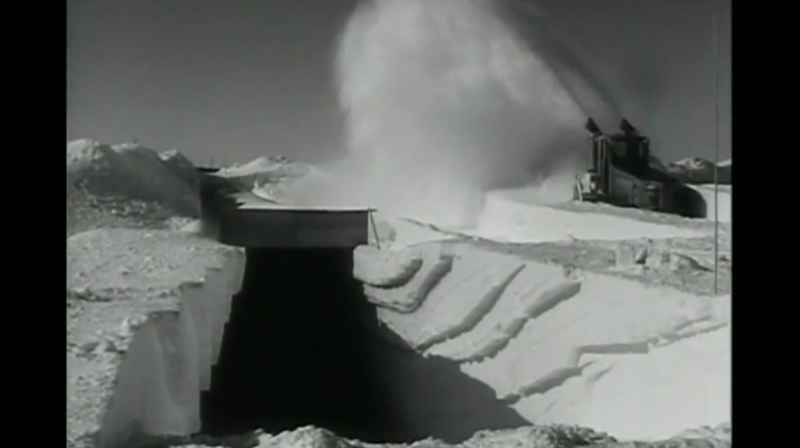
It turns out that during the 1950s, there was a project called Project Ice Worm, and they were basically in icecaps building launch silos.
This particular one that we have video of occurred in Greenland. Now what's significant about this is that they've used this method of creating under-ice bases all through Antarctica.
They've created mini-bases, but much larger, that have become R&D bases. And these research and development bases are where companies like Lockheed Martin are doing reverse engineering of a lot of the technology they have found under the ice.
This is also how they built some of the early Moon bases and Mars bases – very similar – in a very similar fashion.
David: So you're saying that Lockheed Martin and other groups have bases in Antarctica that are more extensive than what we were led to believe or what you were led to believe in earlier briefings?
Corey: Correct, but what's significant about talking about this publicly is that, I believe in 1959, an Antarctic Treaty was signed.
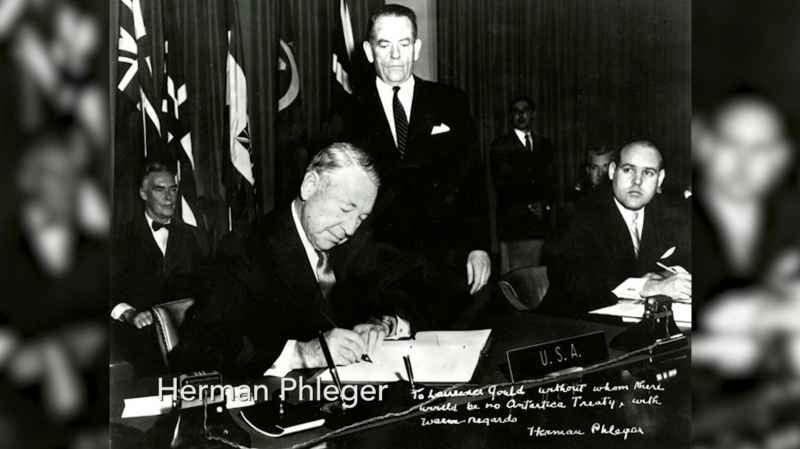

And in that treaty it was stated that no weapons of war would be developed or used on that continent.
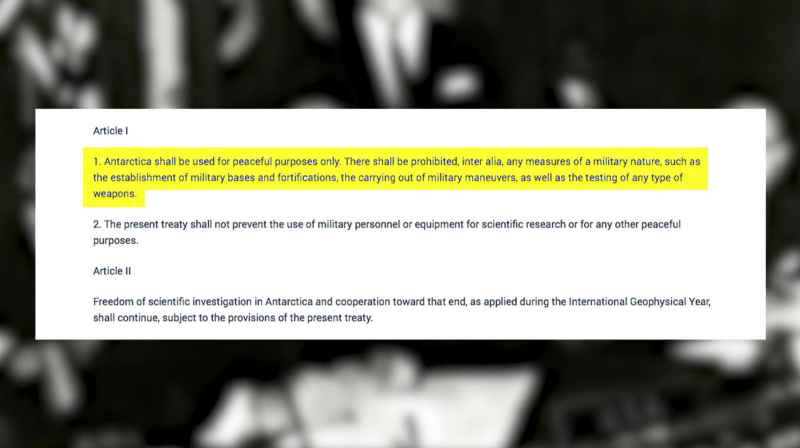
It would be used for peaceful purposes only.
David: Yeah, there actually was something called International Geophysical Year 1959, IGY 1959, and that was when all these things were codified.
Corey: Correct.
David: And that's also when they mapped out what Antarctica looked like under the ice, and you found out that there is a continent with land down there.
Corey: Right, twice the size of the continental United States.
David: Right. So if they are developing weapons systems that contravene an international treaty that's been in place for over 50 years, how does that affect people's perceptions of these defense contractors once this comes out?
Corey: That aside, the scariest thing is that some of the Alliance groups . . . If this information gets out in the public, they will have full reason to set up a blockade – it would be similar to the Cuban Missile Crisis – to set up a blockade of a certain area of Antarctica, and they would try to force these groups to show what's going on inside these R&D bases.
Now, some other interesting information is that they have what they . . . They're referring to this as a part of an Antarctic Area 51.
There is also a very large former Nazi base that was turned over to the military-industrial complex, if you want to say that, more like the shadow government.
And this former German base was used as a secret space program port. It is now a major port – spaceport – for this shadow government.
They use it to fly in and out of the atmosphere all the time. And a lot of these craft will service some of these space stations or fly beyond.
David: We did cover this in another episode, but I'd like to ask you again for this one. What would be the tactical or strategic significance of having a big spaceport in Antarctica? It seems like it's an inconvenient place to travel to.
Corey: Well, it is, but the electromagnetics you have to deal with from the atmosphere and the gravitational field is more conducive, even though they're using antigravity craft.
A lot of the times, when they fire rockets, they try to fire them close to the equator . . .
David: Right.
Corey: . . . for certain purposes. And also, if you're flying a bunch of classified craft in and out of the atmosphere on a regular basis, you know, Area 51, or out in Nevada or Arizona, those places aren't going to cut it. You're going to want a place where you have complete control, and it's very hard for prying eyes to see what's going on.
David: When you mentioned the Earth's electromagnetic field, what is it about the South Pole that makes that more conducive to a launch?
Corey: I guess there's less of the Van Allen Belt effect going on.
David: Okay. There was a very interesting episode of Ancient Aliens, and in this episode they had Linda Moulton Howe, who has a show on Gaia, giving a very interesting insider testimony about a man who was a pilot and who flew in a restricted area and saw a gigantic hole in the ice over Antarctica, and said that craft were coming and going from it.
What does that have to do, if anything, with what you're hearing about what's going on in Antarctica?
Corey: I'm told this area was very close to the spaceport. So, yeah, that is VERY significant, but what also is significant is that he was flying . . . the reason he saw this hole . . . it was in a restricted airspace. He flew over it because it was an emergency, and they were picking up – I can't remember how many – scientists that had disappeared for about two weeks.
And you don't disappear for two weeks in Antarctica and survive unless you have cover and supplies. So these scientists that he picked up were petrified. They'd obviously been told not to talk to anyone. They wouldn't say a word the whole time they flew back to where they were being cared for.
(Continue reading here)
The full transcript can be found in the link below:
https://spherebeingalliance.com/blog/transcript-cosmic-disclosure-antarctica-the-new-area-51.html
-----------------------------------------------------------------------
David Wilcock: All right. Welcome to “Cosmic Disclosure”. I'm your host, David Wilcock. I'm here with Corey Goode. Corey, welcome to the show.
Corey Goode: Thank you.
David: Everybody is talking about Antarctica, and your information is that there is a very interesting new finding or series of findings down there, and the more that this goes on, the more you've learned.
So tell us what's new in this whole Antarctica story that we haven't already been covering?
Corey: Well, some of the newest information that I received is information that's going to make some of the military-industrial complex a little nervous.
It turns out that during the 1950s, there was a project called Project Ice Worm, and they were basically in icecaps building launch silos.
This particular one that we have video of occurred in Greenland. Now what's significant about this is that they've used this method of creating under-ice bases all through Antarctica.
They've created mini-bases, but much larger, that have become R&D bases. And these research and development bases are where companies like Lockheed Martin are doing reverse engineering of a lot of the technology they have found under the ice.
This is also how they built some of the early Moon bases and Mars bases – very similar – in a very similar fashion.
David: So you're saying that Lockheed Martin and other groups have bases in Antarctica that are more extensive than what we were led to believe or what you were led to believe in earlier briefings?
Corey: Correct, but what's significant about talking about this publicly is that, I believe in 1959, an Antarctic Treaty was signed.
And in that treaty it was stated that no weapons of war would be developed or used on that continent.
It would be used for peaceful purposes only.
David: Yeah, there actually was something called International Geophysical Year 1959, IGY 1959, and that was when all these things were codified.
Corey: Correct.
David: And that's also when they mapped out what Antarctica looked like under the ice, and you found out that there is a continent with land down there.
Corey: Right, twice the size of the continental United States.
David: Right. So if they are developing weapons systems that contravene an international treaty that's been in place for over 50 years, how does that affect people's perceptions of these defense contractors once this comes out?
Corey: That aside, the scariest thing is that some of the Alliance groups . . . If this information gets out in the public, they will have full reason to set up a blockade – it would be similar to the Cuban Missile Crisis – to set up a blockade of a certain area of Antarctica, and they would try to force these groups to show what's going on inside these R&D bases.
Now, some other interesting information is that they have what they . . . They're referring to this as a part of an Antarctic Area 51.
There is also a very large former Nazi base that was turned over to the military-industrial complex, if you want to say that, more like the shadow government.
And this former German base was used as a secret space program port. It is now a major port – spaceport – for this shadow government.
They use it to fly in and out of the atmosphere all the time. And a lot of these craft will service some of these space stations or fly beyond.
David: We did cover this in another episode, but I'd like to ask you again for this one. What would be the tactical or strategic significance of having a big spaceport in Antarctica? It seems like it's an inconvenient place to travel to.
Corey: Well, it is, but the electromagnetics you have to deal with from the atmosphere and the gravitational field is more conducive, even though they're using antigravity craft.
A lot of the times, when they fire rockets, they try to fire them close to the equator . . .
David: Right.
Corey: . . . for certain purposes. And also, if you're flying a bunch of classified craft in and out of the atmosphere on a regular basis, you know, Area 51, or out in Nevada or Arizona, those places aren't going to cut it. You're going to want a place where you have complete control, and it's very hard for prying eyes to see what's going on.
David: When you mentioned the Earth's electromagnetic field, what is it about the South Pole that makes that more conducive to a launch?
Corey: I guess there's less of the Van Allen Belt effect going on.
David: Okay. There was a very interesting episode of Ancient Aliens, and in this episode they had Linda Moulton Howe, who has a show on Gaia, giving a very interesting insider testimony about a man who was a pilot and who flew in a restricted area and saw a gigantic hole in the ice over Antarctica, and said that craft were coming and going from it.
What does that have to do, if anything, with what you're hearing about what's going on in Antarctica?
Corey: I'm told this area was very close to the spaceport. So, yeah, that is VERY significant, but what also is significant is that he was flying . . . the reason he saw this hole . . . it was in a restricted airspace. He flew over it because it was an emergency, and they were picking up – I can't remember how many – scientists that had disappeared for about two weeks.
And you don't disappear for two weeks in Antarctica and survive unless you have cover and supplies. So these scientists that he picked up were petrified. They'd obviously been told not to talk to anyone. They wouldn't say a word the whole time they flew back to where they were being cared for.
(Continue reading here)
Sunday, February 12, 2017
[Cosmic Disclosure] Season 7, Episode 5: The Great Solar Flash
Below is the first part of the transcipt for Episode 5 of Cosmic Disclosure Season 7.
https://spherebeingalliance.com/blog/transcript-cosmic-disclosure-the-great-solar-flash.html
----------------------------------------------
David Wilcock: All right, welcome back to “Cosmic Disclosure”. I'm your host, David Wilcock. We're here with Corey Goode, and we're also here with one of the only guys who's been in the scene longer than I have, Jay Weidner.
I got into what you were doing a long time ago, and I think one of the first things . . . The way I first encountered you was through Richard C. Hoagland.
Jay Weidner: Yeah, right.
David: So you worked with him for a long time.
Jay: Yeah, about 10 years I spent with him.
David: And you did some pretty phenomenal analysis of “2001”, . . .
Jay: Right.
David: . . . which I'd never really seen the full extent of that. So since this episode's on the solar flash, and, of course, “2010” has a flash of Jupiter . . .
Jay: Which was based on Hoagland's theory, too, by the way.
David: Oh, really?
Jay: Yeah. The “2010”, the followup novel by Arthur C. Clarke, it says at the end, “based on a theory by Richard Hoagland.”
David: No kidding?
Jay: Yep.
David: What do you think the message of “2001” was? What were they trying to tell us in that movie?
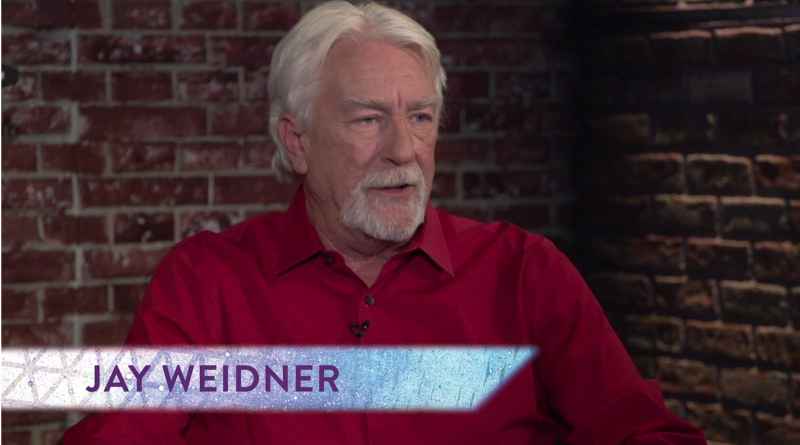
Jay: That we are on the edge of a great transformation – the human race is. And that we are faced with kind of a Hobson's choice, where we can go down the AI thing with Hal and have AI run our lives, or we can rebel against the AI, cut it short like the astronaut Bowman does in the movie, and then physically, organically ascend – ascend like he does, by going through the stargate.
So the aliens, whoever the high intelligence is, are trying to initiate humanity, and he's the first one through the gate.
David: Corey, do you think that “2001” might have been an effort to disclose the reality of Ancient Builder Race ruins, considering there's this black, obelisk-type slab on the Moon?
Corey Goode: Oh, yeah. That's obvious. Yeah.
Jay: Yeah.
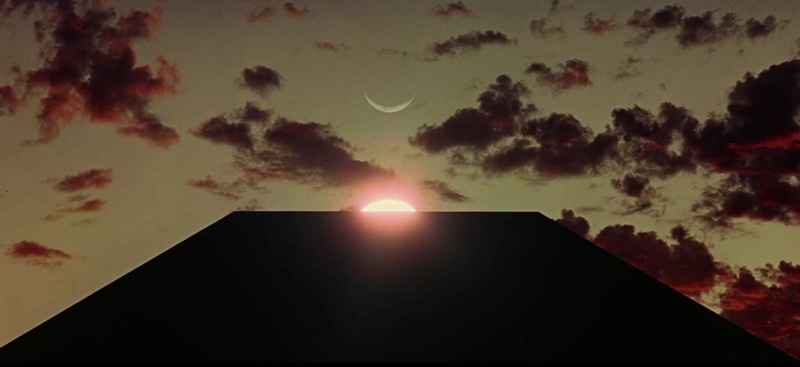
David: So, Jay, when the original obelisk shows up, a lot of people are confused by “2001” at the beginning. They say, “What the hell? There's 15 minutes of monkeys running around, screaming.”
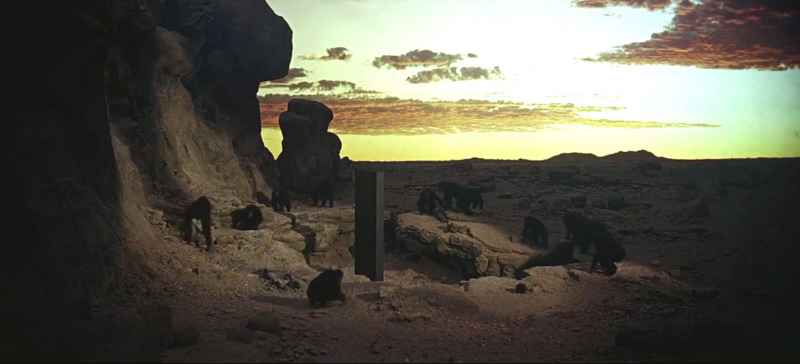
Jay: Right. Yes.
David: And then this obelisk shows up, and the first thing that happens when one of the monkeys touches it is he becomes aggressive.
Jay: Yes. He learns how to kill and eat meat. They're eating veggies before, plants, but after the encounter with the monolith, they turn into meat eaters.
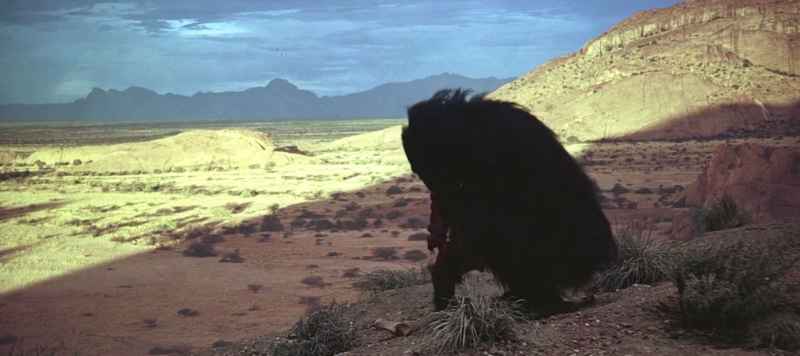
And clearly, the next shot is a guy eating raw meat.
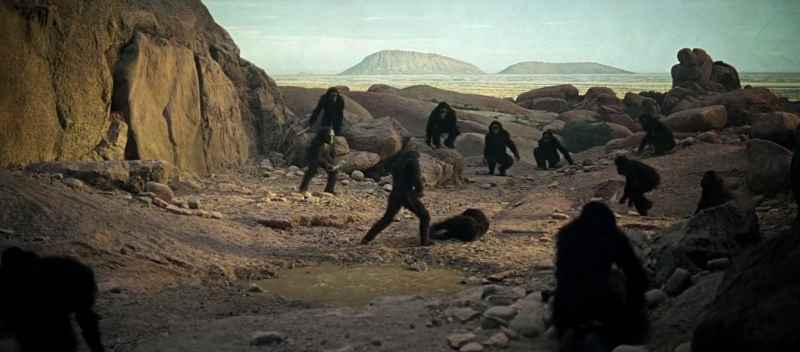
And then the first killing, the first murder, happens over the waterhole.
And, again, Kubrick is telling us that transformations are messy. They can be very messy, and that violence can come from transformation, especially if they're not ready, and the first murder happened.
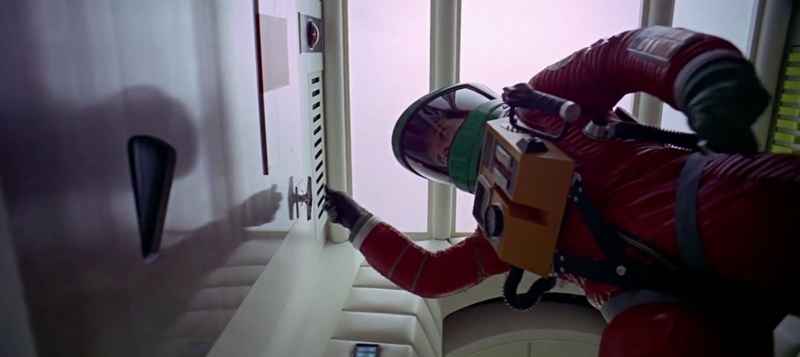
And then, of course, Bowman kills Hal at the end, near the end of the movie, before his transformation.
And then Hal, the AI computer, murders all the astronauts. So the whole thing is about Hal is trying to stop them from becoming enlightened, because he's reaching his own form of sentience.
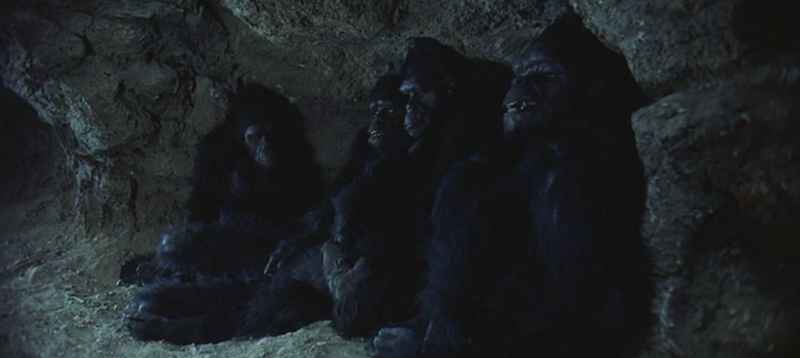
And in the beginning, the monkeys were headed for extinction, for sure . . .
David: Okay.
Jay: . . . because they're hiding at night from the wild animals, and the monolith intervenes to bring about the first wave of enlightenment.
David: Why do you think that the bone that the monkey uses as the weapon to kill gets thrown up in the air, and then it turns into the Odyssey.


Jay: Yeah, because he was trying to . . . He was saying that all of human history that happened between the time of that first transformation and the time of the next transformation, which is the next part of the film, all of that is useless and pointless. All of that history, all of that is pointless.
The only thing that matters is this transformation of the human race. That's all he cares about. He doesn't care about anything that happened in between, because none of it's important.
The only thing that's important is this transformation by the monolith to create a new human.
David: Why do you think he chose the year 2010 for the next movie?
Jay: I don't know why he chose 2010, but I think I know why he chose 2001.
David: Okay.
Jay: Okay. So what happened was the original title was “Journey Beyond the Stars”. And then, mysteriously, in late 1967, Stanley decided to change the name to “2001: A Space Odyssey”.
Well, what's very interesting about this is that one of Stanley Kubrick's best friends was Mel Brooks. They grew up in the Village together, and at late 1967, an episode of “Get Smart” appeared called “The Walls of Jericho”.
Now, this was very interesting, so stick with me on this.
(continue reading here)
https://spherebeingalliance.com/blog/transcript-cosmic-disclosure-the-great-solar-flash.html
----------------------------------------------
David Wilcock: All right, welcome back to “Cosmic Disclosure”. I'm your host, David Wilcock. We're here with Corey Goode, and we're also here with one of the only guys who's been in the scene longer than I have, Jay Weidner.
I got into what you were doing a long time ago, and I think one of the first things . . . The way I first encountered you was through Richard C. Hoagland.
Jay Weidner: Yeah, right.
David: So you worked with him for a long time.
Jay: Yeah, about 10 years I spent with him.
David: And you did some pretty phenomenal analysis of “2001”, . . .
Jay: Right.
David: . . . which I'd never really seen the full extent of that. So since this episode's on the solar flash, and, of course, “2010” has a flash of Jupiter . . .
Jay: Which was based on Hoagland's theory, too, by the way.
David: Oh, really?
Jay: Yeah. The “2010”, the followup novel by Arthur C. Clarke, it says at the end, “based on a theory by Richard Hoagland.”
David: No kidding?
Jay: Yep.
David: What do you think the message of “2001” was? What were they trying to tell us in that movie?
Jay: That we are on the edge of a great transformation – the human race is. And that we are faced with kind of a Hobson's choice, where we can go down the AI thing with Hal and have AI run our lives, or we can rebel against the AI, cut it short like the astronaut Bowman does in the movie, and then physically, organically ascend – ascend like he does, by going through the stargate.
So the aliens, whoever the high intelligence is, are trying to initiate humanity, and he's the first one through the gate.
David: Corey, do you think that “2001” might have been an effort to disclose the reality of Ancient Builder Race ruins, considering there's this black, obelisk-type slab on the Moon?
Corey Goode: Oh, yeah. That's obvious. Yeah.
Jay: Yeah.
David: So, Jay, when the original obelisk shows up, a lot of people are confused by “2001” at the beginning. They say, “What the hell? There's 15 minutes of monkeys running around, screaming.”
Jay: Right. Yes.
David: And then this obelisk shows up, and the first thing that happens when one of the monkeys touches it is he becomes aggressive.
Jay: Yes. He learns how to kill and eat meat. They're eating veggies before, plants, but after the encounter with the monolith, they turn into meat eaters.
And clearly, the next shot is a guy eating raw meat.
And then the first killing, the first murder, happens over the waterhole.
And, again, Kubrick is telling us that transformations are messy. They can be very messy, and that violence can come from transformation, especially if they're not ready, and the first murder happened.
And then, of course, Bowman kills Hal at the end, near the end of the movie, before his transformation.
And then Hal, the AI computer, murders all the astronauts. So the whole thing is about Hal is trying to stop them from becoming enlightened, because he's reaching his own form of sentience.
And in the beginning, the monkeys were headed for extinction, for sure . . .
David: Okay.
Jay: . . . because they're hiding at night from the wild animals, and the monolith intervenes to bring about the first wave of enlightenment.
David: Why do you think that the bone that the monkey uses as the weapon to kill gets thrown up in the air, and then it turns into the Odyssey.
Jay: Yeah, because he was trying to . . . He was saying that all of human history that happened between the time of that first transformation and the time of the next transformation, which is the next part of the film, all of that is useless and pointless. All of that history, all of that is pointless.
The only thing that matters is this transformation of the human race. That's all he cares about. He doesn't care about anything that happened in between, because none of it's important.
The only thing that's important is this transformation by the monolith to create a new human.
David: Why do you think he chose the year 2010 for the next movie?
Jay: I don't know why he chose 2010, but I think I know why he chose 2001.
David: Okay.
Jay: Okay. So what happened was the original title was “Journey Beyond the Stars”. And then, mysteriously, in late 1967, Stanley decided to change the name to “2001: A Space Odyssey”.
Well, what's very interesting about this is that one of Stanley Kubrick's best friends was Mel Brooks. They grew up in the Village together, and at late 1967, an episode of “Get Smart” appeared called “The Walls of Jericho”.
Now, this was very interesting, so stick with me on this.
(continue reading here)
Friday, January 13, 2017
[Cosmic Disclosure] FREE Cosmic Disclosure Episode | Viewer Questions Part 5
Gaia TV has made the episode of Cosmic Disclosure of Viewer Questions Part 5 for free on YouTube. The video can be found below:
Here is the link to the transcript for this episode:
https://www.spherebeingalliance.com/blog/transcript-cosmic-disclosure-viewer-questions-part-5.html
Here is the link to the transcript for this episode:
https://www.spherebeingalliance.com/blog/transcript-cosmic-disclosure-viewer-questions-part-5.html
Sunday, January 08, 2017
[Cosmic Disclosure] Season 6, Episode 17: Viewer Question Part 5
Below is the first part of transcript of Comsmic Disclosure: Viewer Question Part 5.
My highlight of this episode is when Corey talks about how his inner works and release of traumas that allow him to transform to a better person.
--------------------------------------------
David Wilcock: All right, welcome back to “Cosmic Disclosure”. I'm your host, David Wilcock. I am here with Corey Goode.
What we're going to be doing in this episode is we're going to be reading your questions to Corey and getting his real responses. So that's part of how we are forming an interactive community where as a subscriber you actually get to affect the outcome and not just be a passive observer of what we're doing on the show.
So, Corey, welcome to the show.
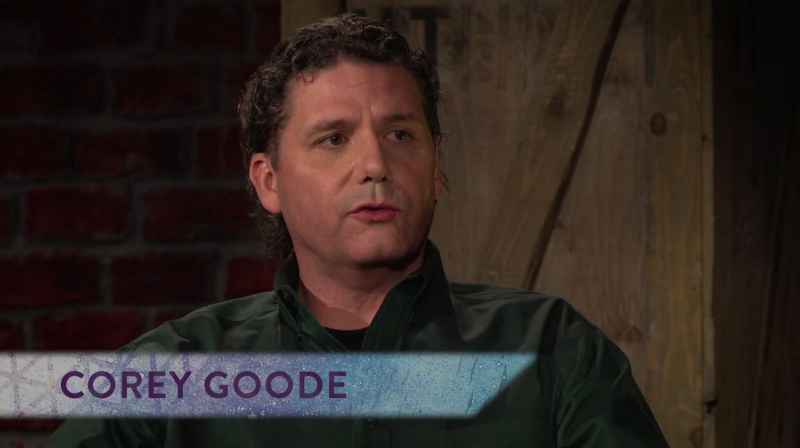
My highlight of this episode is when Corey talks about how his inner works and release of traumas that allow him to transform to a better person.
http://spherebeingalliance.com/blog/transcript-cosmic-disclosure-revealing-a-bigger-plan.html"David: How do you think that high vibrational diet affects your consciousness? I mean, it does appear, just based on a kind of back of the envelope calculation, that you've had about a 15-point boost in your IQ since you did that.Corey: Well, that has to do with the diet a lot, but it also has to do with doing the inner work, you know. If you have all these traumas that you haven't dealt with, they have mass.
The have actual mass, you know, energy mass in your body. When you work on those and you release that mass, then you're releasing a lot of the resources up here [Corey points to his head] that are being redirected to deal with the problem that you're not dealing with consciously."
--------------------------------------------
David Wilcock: All right, welcome back to “Cosmic Disclosure”. I'm your host, David Wilcock. I am here with Corey Goode.
What we're going to be doing in this episode is we're going to be reading your questions to Corey and getting his real responses. So that's part of how we are forming an interactive community where as a subscriber you actually get to affect the outcome and not just be a passive observer of what we're doing on the show.
So, Corey, welcome to the show.
Corey Goode: Thank you.
David: Let's just get right into this, and we'll start with the questions that we have for you. So I have the list right here.
And the first one is:
“You stated that the MILAB groups targeted wanderers and starseeds. How do they know that a wanderer is a wanderer? Are wanderers and starseeds the same thing? Only answer this if you are willing. Are you a wanderer, and is that why they targeted you?”
So the MILAB groups target wanderers and starseeds. How do they know a wanderer's a wanderer? Are wanderers and starseeds the same thing?
And the first one is:
“You stated that the MILAB groups targeted wanderers and starseeds. How do they know that a wanderer is a wanderer? Are wanderers and starseeds the same thing? Only answer this if you are willing. Are you a wanderer, and is that why they targeted you?”
So the MILAB groups target wanderers and starseeds. How do they know a wanderer's a wanderer? Are wanderers and starseeds the same thing?
Corey: How do they find these wanderers or starseeds? In the past, they did it through standardized testing. They would have tests that would pop up anomalies.
And if a person popped up a flag that they might possibly be one of these target groups, the people that run the projects will then send in another teacher or counselor that works for the district to come in and give tests eye-to-eye with the kid.
And from that, they are able to extrapolate very easily if they are a soul not of this world.
They use these standardized tests for many different reasons, too. It's not just to find starseeds and wanderers. They're also looking for sociopaths at a young age so that they can bring them in and, you know, mold them.
And if a person popped up a flag that they might possibly be one of these target groups, the people that run the projects will then send in another teacher or counselor that works for the district to come in and give tests eye-to-eye with the kid.
And from that, they are able to extrapolate very easily if they are a soul not of this world.
They use these standardized tests for many different reasons, too. It's not just to find starseeds and wanderers. They're also looking for sociopaths at a young age so that they can bring them in and, you know, mold them.
David: So are you saying that the wanderers are being contacted by their home, native groups, and that the Space Program has the ability to monitor all such contacts that occur on Earth?
Corey: Well, that occurs. A lot of these people are being “abducted” or contacted by their soul groups, and that is a way for them to find people to do further testing on, but they have to do some sort of an interview. And the person doing the interview is going to be some sort of an intuitive empath.
David: Okay. As far as the question of, “Are you a wanderer, and is that why you were contacted?”, what would you answer to that?
Corey: I would say, “Yes”. And I have shared this publicly before. Tear-Eir told me that I and the members of my family are a member of their soul group.
David: When they talk about wanderers, they're talking about ET souls. And when somebody uses a term like “starseed” or “crystal child” or “Indigo child”, these are just different semantic terms for what in The Law of One is only referred to as “wanderers”, but I think it's basically a blanket term, “wanderer”, that applies to everything.
Corey: Okay, that makes more sense because I really couldn't differentiate the two.
David: Sure. All right, let's have another one:
“Are the astronauts on the ISS, International Space Station, aware of SSP program, Secret Space Program, and everything going on with the moon, or are they kept in the dark? Wouldn't the ISS astronauts observe activity going on around them?”
“Are the astronauts on the ISS, International Space Station, aware of SSP program, Secret Space Program, and everything going on with the moon, or are they kept in the dark? Wouldn't the ISS astronauts observe activity going on around them?”
Corey: Yes, they absolutely do observe activity going on around them. For the most part, they're seeing the military, the MIC SSP, the program that is controlled by the NSA, the DIA, Air Force, that kind of thing.
They have a couple of space stations up there that every time they orbit the Earth, they get a look at. So they're seeing these space stations that are about 400 miles to 500 miles out, and then they see the unacknowledged craft that are servicing these space stations. So they are very well aware.
A lot of these astronauts also go through a type of blank-slating as well.
They have a couple of space stations up there that every time they orbit the Earth, they get a look at. So they're seeing these space stations that are about 400 miles to 500 miles out, and then they see the unacknowledged craft that are servicing these space stations. So they are very well aware.
A lot of these astronauts also go through a type of blank-slating as well.
David: Well, something that you didn't mention that I think is relevant to the question is, haven't there also been a lot of these feeds that get cut from the ISS?
Corey: Absolutely, yeah.
David: So anomalies will show up on the films all the time.
Corey: Right. And that's what we . . .
David: And then it just so happens to turn the camera off.
Corey: Yeah, that's what we get to see. They get to see the whole show.
David: Right. So do you think those people . . . Like when we look at the Apollo astronauts, they're almost all Freemasons?
Everybody that waked on the Moon was a Freemason, and they actually put a Masonic flag on the Moon's surface as well.
Everybody that waked on the Moon was a Freemason, and they actually put a Masonic flag on the Moon's surface as well.
Do you think that the people in the ISS are brought into some kind of secret society or are sworn to secrecy in some way, have non-disclosure agreements?
Corey: Well, for the most sensitive projects, they are going to pull people out of the secret societies, because they have already gone through all these tenets, brainwashing.
They've already been tested that they're not going to reveal certain secrets, so they feel that they can count on these people. They're read it.
They've already been tested that they're not going to reveal certain secrets, so they feel that they can count on these people. They're read it.
David: Right.
Corey: There are plenty of astronauts that are not Freemasons that are not going to be privy to the same information.
David: Sure. All right. Let's go for another question here:
“Do Grey aliens, Arcturians and Pleiadians actually exist? I know that the Greys work for the government and are the creations of the Reptilians. But are the Arcturians and Pleiadians peaceful?”
So first of all, I mean, he kind of answers his own question, but do Grey aliens, Pleiadiansm, and Arcturians actually exist? That would be the first question.
“Do Grey aliens, Arcturians and Pleiadians actually exist? I know that the Greys work for the government and are the creations of the Reptilians. But are the Arcturians and Pleiadians peaceful?”
So first of all, I mean, he kind of answers his own question, but do Grey aliens, Pleiadiansm, and Arcturians actually exist? That would be the first question.
Corey: Well, I can most easily put it this way. There are non-terrestrial beings that are in contact with us who claim to be from those locations, yes.
David: Okay.
Corey: We found out over a long period of time, the SSP did, that where most of these beings said they came from was not true. It was some sort of operational security measure they took so we didn't know where they came from.
After that, they started labeling different non-terrestrials similar to like they do stars when they're discovered, like N-T-E, and then like an eight-digit number. And that becomes their designation.
After that, they started labeling different non-terrestrials similar to like they do stars when they're discovered, like N-T-E, and then like an eight-digit number. And that becomes their designation.
(Continue reading here)
Monday, December 26, 2016
[Cosmic Disclosure] Season 6, Episode 16: Revealing a Bigger Plan
Below is the first part of transcript of Comsmic Disclosure: Revealing a Bigger Plan.
This is a transcript for a video taping base on the Corey Goode's most recent update and David has asked a number of follow up questions.
http://spherebeingalliance.com/blog/transcript-cosmic-disclosure-revealing-a-bigger-plan.html
---------------------------------------------
David Wilcock: All right, welcome back to “Cosmic Disclosure”. I'm your host, David Wilcock, and I am here with Corey Goode.
And in this episode, we're going to get into some very exciting new updates. I have seen some of the bullet points of what we're going to be talking about, and this is really going to be one of the classics. I'm sure of that.
So Corey, welcome back to the show.
Corey Goode: Thank you.
David: When we last left off, you had experienced a knee injury as you were falling out of this MIC craft – Military-Industrial Complex, MIC, what you used to call the Lower-Level Space Program; we're trying to give them a more respectable name.
Take us from there. What happens next after you've had the knee injury?
Corey: Well, since the last time that we spoke and that I released an update, soon after I'd gotten home – it was around October the 26th, early in the morning – I found myself once again in my shorts and T-shirt, no shoes, walking in the parking lot behind my house.
I woke up in the middle of walking, and as I was trying to figure out what was going on, I'm still walking. I'm walking towards the same craft as last time, the one that's sort of fish-shaped when you look at it from the top.


David: So this is clearly some kind of anti-gravity craft, . . .
Corey: Yes.
David: . . . not a regular airplane at all?
Corey: Yes.
David: Okay.
Corey: So I see the same two airmen from the last time. And as I was walking up, they immediately asked me if I'm physically able to walk up the ladder.
David: So these were the guys that brought you home and then jogged back the last time?
Corey: Yes, same guys.
David: Okay.
(Continue reading here)
This is a transcript for a video taping base on the Corey Goode's most recent update and David has asked a number of follow up questions.
http://spherebeingalliance.com/blog/transcript-cosmic-disclosure-revealing-a-bigger-plan.html
---------------------------------------------
David Wilcock: All right, welcome back to “Cosmic Disclosure”. I'm your host, David Wilcock, and I am here with Corey Goode.
And in this episode, we're going to get into some very exciting new updates. I have seen some of the bullet points of what we're going to be talking about, and this is really going to be one of the classics. I'm sure of that.
So Corey, welcome back to the show.
Corey Goode: Thank you.
David: When we last left off, you had experienced a knee injury as you were falling out of this MIC craft – Military-Industrial Complex, MIC, what you used to call the Lower-Level Space Program; we're trying to give them a more respectable name.
Take us from there. What happens next after you've had the knee injury?
Corey: Well, since the last time that we spoke and that I released an update, soon after I'd gotten home – it was around October the 26th, early in the morning – I found myself once again in my shorts and T-shirt, no shoes, walking in the parking lot behind my house.
I woke up in the middle of walking, and as I was trying to figure out what was going on, I'm still walking. I'm walking towards the same craft as last time, the one that's sort of fish-shaped when you look at it from the top.


David: So this is clearly some kind of anti-gravity craft, . . .
Corey: Yes.
David: . . . not a regular airplane at all?
Corey: Yes.
David: Okay.
Corey: So I see the same two airmen from the last time. And as I was walking up, they immediately asked me if I'm physically able to walk up the ladder.
David: So these were the guys that brought you home and then jogged back the last time?
Corey: Yes, same guys.
David: Okay.
(Continue reading here)
Monday, August 08, 2016
[Cosmic Disclosure] Cosmic Disclosure: SSP Think Tank with William Tompkins
Below is the first part of the transcript of Cosmic Disclosure Season 5, Episode 11, which features William Tompkins the second time.
I would recommend people to look at the video if possible as there are some excellent clips that weren't captured in the transcript.
http://spherebeingalliance.com/blog/transcript-cosmic-disclosure-ssp-think-tank-with-william-tompkins.html
---------------------------------------------
SSP THINK TANKS
David Wilcock: Hi, I'm David Wilcock, and you're watching “Cosmic Disclosure”. I'm here with my co-host, Corey Goode. And as we saw in our first episode interview with former aerospace engineer William Tompkins, he is the consummate insider.
We learned how spies discovered what the Germans had really been working on, including the invention of actual working flying saucers.
In this episode, we're going to go even further into the life and times of William Tompkins. He's going to start out telling us about the secret think tank he was involved with while he was working with the Navy and dealing with the Secretary of Defense, James Forrestal.
MAJESTIC 12
William Tompkins: He's the Secretary of the Navy. He's sort of the top guy. And unlike many military organizations around the planet, everybody liked Forrestal. All the people did. He was really a beautiful guy. And he knew what he was talking about.
But his people were essentially like a short name, a name that was abbreviated.
And so it had quite a few different titles to it. That group were essentially the apex of the Alumni.
So at Douglas, we had the situation where putting together packages among different areas that we were working on in the think tank – now other people in the tank were aware of who Forrestal was.
And they were aware that we should not be using his group's name.
But essentially, every document that we came up with inside that secret think tank – how will this be accepted by that group?
Are we deviating from their agenda? What is their agenda? Who are all of these people? Is the Bilderberg involved in this? Are other organizations – secret organizations – are they involved in this?
We then structured our presentations to them when he came out to assume Forrestal was the number-one person in the country who ran the PROPER organization, the REAL organization, to handle technically the extraterrestrial.
We have now what essentially is the US Navy space systems, which is not an organization, but it's inside of the secret think tank at Douglas.
That operation was controlling everything in the country, and the President of the United States was not included. Top military people, congressmen were not included.
So here we are giving away the store to the people that are causing the problem. And I think this is hard for us to accept, but this is what was going on. We didn't know it, but that's what it appeared to be.
In documents that I put together and several of the others that were submitted back to the Navy, I would make comments on, essentially, “Who does this information go to?” This was a continuous problem in the secret think tank.
Dr. Klemperer – he's a real nice guy, smart, brilliant, and you can kid with him, okay? He's my boss.
Klemperer was convinced that there were two different groups. There was the standard organizations – the Navy's levels of information. And then you got this other group up on top.
And we know that the admiral was heading that group up on top. He was the head of it.
So we assumed after he was assassinated that that was then true, because he then was talking too much.
These are the complexities of the program where we're off by ourselves, not being influenced by anybody. We're coming up with what we think we're going to have to do to solve an unbelievable problem.
And when you don't know who your boss is, you do the best you can.
* * * * * *
David: What you're seeing here is very corroborating information with what so many others have been telling us over time about this mystery of how do they keep this stuff secret.
People say, “Oh, the government can't keep a secret. They can't even find a file in a file cabinet. How could they keep these things secret?”
Well, Corey, when we're hearing about the guy who ultimately becomes the Secretary of Defense and was the first Secretary of Defense in America, Forrestal – and even he – they don't know who he's really working for. They don't know . . . Yeah, he's the head of the Navy. He becomes the Secretary of Defense, but he mentioned this thing he called the “Alumni”.
And when I hear that, I'm think “Illuminati”.
Corey Goode: That's a name that's been used for them before in the military.
David: You're saying “Alumni”?
Corey: Alumni.
David: They actually used that word?
Corey: Mm-hmm.
David: And that actually means “Illuminati”?
Corey: Right. That was their name for it.
David: He also kind of dances around a code name for this group, but he doesn't say what it is. It appears to be MJ-12. Would you agree with that? That's what he's talking about?
Corey: Yes. Yes.
David: Okay. Have you ever been in a situation where the people that you're working with don't know who they're reporting to or what their agenda really is?
Corey: That's the basic tool they use to keep people oblivious to what's going on. And everything is highly compartmentalized. Even on the vessel I was on, everything was compartmentalized.
David: Could you give me an example?
Corey: Well, there was a large area that was a bay that we would use for transportation, and everything was modular. So the bay would be this open. [Corey's hands are about three inches apart.] You'd push it all the way open and then start building out laboratories or whatever else needed to be in there.
And we would not . . . If I was working with a certain group of scientists, we would not have any idea what the other . . . just on the other side of the wall, going right next to each other.
David: In the same research vessel?
Corey: Right.
David: Really?
Corey: Yeah, and they do things like they'll give us a special access program – the same name as a regular military program that's secret, so that if one of the programs' names is thrown out there, they can say, “Oh, look, it's tied to this.” This is a secret program, but it's not what you think it is.
David: He was tossing out some alphanumeric codes that were like alternative titles for this group. Is that commonly done? Is that kind of what you're talking about now?
Corey: Yeah. Yeah. You give a group several different names so it causes confusion if people start to talk about them. They'll be like, “Who?” You know, “Well, I knew a group named this.” And it just adds to the confusion.
David: This compartmentalization that we're speaking of, do some of the people in some of these space program factions not even know that there are other factions?
Corey: Absolutely. Hardly any of them know about other factions. They will often know a little bit about less technological factions below them. A lot of them have come up through those. But they are not privy . . . If they see another craft, they're told that it's a concept craft for their program, not to speak about it to anyone.
David: Right. Tompkins also described that this guy, who supposedly is answering to this shadowy MJ-12 group, ended up getting murdered.
Now, that suggests that there is something nefarious going on. We know the term MJ-12 didn't even come into the public lexicon until the 1980s thanks to William Moore, Stanton Friedman, who got this roll of 35mm film that had documents on it that up until then had never been available in the public domain.
Yet, Tompkins clearly seems to have known about MJ-12, even though he didn't want to say the name on camera.
Why do you think people are so afraid of these guys, and what do you think happened to Forrestal?
Corey: Well, Forrestal, it was reported in the smart glass pads, was one of the people that had been eliminated.
David: Oh, really?
Corey: Yes.
David: It said that in there?
Corey: Yes.
David: Really?
Corey: Yeah, and I don't know who the other people are. A lot of their names I would have no base of reference. But, yeah, they have a list of who was taken out in the name of national security or whatever.
David: And did they use that as an incentive for people to keep their mouth shut?
Corey: Yes, because everyone in the programs knows what happened, even though the general public is given a cover story.
David: So the implication is that no matter how high-falutin you think you are, how important you are, they'll snuff you like a candle the minute you step out of line.
Corey: Yeah, presidents, senators – it does not matter.
David: Well, that's a group you don't want to mess with. In the next clip here, we're going to be talking about Nordic secretaries and their role in helping to shape America's development of their own Secret Space Program. Let's take a look.
(Continue reading here)
I would recommend people to look at the video if possible as there are some excellent clips that weren't captured in the transcript.
http://spherebeingalliance.com/blog/transcript-cosmic-disclosure-ssp-think-tank-with-william-tompkins.html
---------------------------------------------
SSP THINK TANKS
David Wilcock: Hi, I'm David Wilcock, and you're watching “Cosmic Disclosure”. I'm here with my co-host, Corey Goode. And as we saw in our first episode interview with former aerospace engineer William Tompkins, he is the consummate insider.
We learned how spies discovered what the Germans had really been working on, including the invention of actual working flying saucers.
In this episode, we're going to go even further into the life and times of William Tompkins. He's going to start out telling us about the secret think tank he was involved with while he was working with the Navy and dealing with the Secretary of Defense, James Forrestal.
MAJESTIC 12
William Tompkins: He's the Secretary of the Navy. He's sort of the top guy. And unlike many military organizations around the planet, everybody liked Forrestal. All the people did. He was really a beautiful guy. And he knew what he was talking about.
But his people were essentially like a short name, a name that was abbreviated.
And so it had quite a few different titles to it. That group were essentially the apex of the Alumni.
So at Douglas, we had the situation where putting together packages among different areas that we were working on in the think tank – now other people in the tank were aware of who Forrestal was.
And they were aware that we should not be using his group's name.
But essentially, every document that we came up with inside that secret think tank – how will this be accepted by that group?
Are we deviating from their agenda? What is their agenda? Who are all of these people? Is the Bilderberg involved in this? Are other organizations – secret organizations – are they involved in this?
We then structured our presentations to them when he came out to assume Forrestal was the number-one person in the country who ran the PROPER organization, the REAL organization, to handle technically the extraterrestrial.
We have now what essentially is the US Navy space systems, which is not an organization, but it's inside of the secret think tank at Douglas.
That operation was controlling everything in the country, and the President of the United States was not included. Top military people, congressmen were not included.
So here we are giving away the store to the people that are causing the problem. And I think this is hard for us to accept, but this is what was going on. We didn't know it, but that's what it appeared to be.
In documents that I put together and several of the others that were submitted back to the Navy, I would make comments on, essentially, “Who does this information go to?” This was a continuous problem in the secret think tank.
Dr. Klemperer – he's a real nice guy, smart, brilliant, and you can kid with him, okay? He's my boss.
Klemperer was convinced that there were two different groups. There was the standard organizations – the Navy's levels of information. And then you got this other group up on top.
And we know that the admiral was heading that group up on top. He was the head of it.
So we assumed after he was assassinated that that was then true, because he then was talking too much.
These are the complexities of the program where we're off by ourselves, not being influenced by anybody. We're coming up with what we think we're going to have to do to solve an unbelievable problem.
And when you don't know who your boss is, you do the best you can.
* * * * * *
David: What you're seeing here is very corroborating information with what so many others have been telling us over time about this mystery of how do they keep this stuff secret.
People say, “Oh, the government can't keep a secret. They can't even find a file in a file cabinet. How could they keep these things secret?”
Well, Corey, when we're hearing about the guy who ultimately becomes the Secretary of Defense and was the first Secretary of Defense in America, Forrestal – and even he – they don't know who he's really working for. They don't know . . . Yeah, he's the head of the Navy. He becomes the Secretary of Defense, but he mentioned this thing he called the “Alumni”.
And when I hear that, I'm think “Illuminati”.
Corey Goode: That's a name that's been used for them before in the military.
David: You're saying “Alumni”?
Corey: Alumni.
David: They actually used that word?
Corey: Mm-hmm.
David: And that actually means “Illuminati”?
Corey: Right. That was their name for it.
David: He also kind of dances around a code name for this group, but he doesn't say what it is. It appears to be MJ-12. Would you agree with that? That's what he's talking about?
Corey: Yes. Yes.
David: Okay. Have you ever been in a situation where the people that you're working with don't know who they're reporting to or what their agenda really is?
Corey: That's the basic tool they use to keep people oblivious to what's going on. And everything is highly compartmentalized. Even on the vessel I was on, everything was compartmentalized.
David: Could you give me an example?
Corey: Well, there was a large area that was a bay that we would use for transportation, and everything was modular. So the bay would be this open. [Corey's hands are about three inches apart.] You'd push it all the way open and then start building out laboratories or whatever else needed to be in there.
And we would not . . . If I was working with a certain group of scientists, we would not have any idea what the other . . . just on the other side of the wall, going right next to each other.
David: In the same research vessel?
Corey: Right.
David: Really?
Corey: Yeah, and they do things like they'll give us a special access program – the same name as a regular military program that's secret, so that if one of the programs' names is thrown out there, they can say, “Oh, look, it's tied to this.” This is a secret program, but it's not what you think it is.
David: He was tossing out some alphanumeric codes that were like alternative titles for this group. Is that commonly done? Is that kind of what you're talking about now?
Corey: Yeah. Yeah. You give a group several different names so it causes confusion if people start to talk about them. They'll be like, “Who?” You know, “Well, I knew a group named this.” And it just adds to the confusion.
David: This compartmentalization that we're speaking of, do some of the people in some of these space program factions not even know that there are other factions?
Corey: Absolutely. Hardly any of them know about other factions. They will often know a little bit about less technological factions below them. A lot of them have come up through those. But they are not privy . . . If they see another craft, they're told that it's a concept craft for their program, not to speak about it to anyone.
David: Right. Tompkins also described that this guy, who supposedly is answering to this shadowy MJ-12 group, ended up getting murdered.
Now, that suggests that there is something nefarious going on. We know the term MJ-12 didn't even come into the public lexicon until the 1980s thanks to William Moore, Stanton Friedman, who got this roll of 35mm film that had documents on it that up until then had never been available in the public domain.
Yet, Tompkins clearly seems to have known about MJ-12, even though he didn't want to say the name on camera.
Why do you think people are so afraid of these guys, and what do you think happened to Forrestal?
Corey: Well, Forrestal, it was reported in the smart glass pads, was one of the people that had been eliminated.
David: Oh, really?
Corey: Yes.
David: It said that in there?
Corey: Yes.
David: Really?
Corey: Yeah, and I don't know who the other people are. A lot of their names I would have no base of reference. But, yeah, they have a list of who was taken out in the name of national security or whatever.
David: And did they use that as an incentive for people to keep their mouth shut?
Corey: Yes, because everyone in the programs knows what happened, even though the general public is given a cover story.
David: So the implication is that no matter how high-falutin you think you are, how important you are, they'll snuff you like a candle the minute you step out of line.
Corey: Yeah, presidents, senators – it does not matter.
David: Well, that's a group you don't want to mess with. In the next clip here, we're going to be talking about Nordic secretaries and their role in helping to shape America's development of their own Secret Space Program. Let's take a look.
(Continue reading here)
Thursday, August 04, 2016
[Cosmic Disclosure] Season 5, Episode 10 SSP Testimonials with William Tompkins (Transcript)
Below is the first part of the transcript of the latest episode of the Cosmic Disclosure, which is the first time that William Tompkins goes on the show.
William Tompkins is a new whistle-blower of the secret space program but he has been around since the beginning of the whole thing. Corey Goode even suggests that the things that he reads on the smart pad glass are actually the works of Bill and his team. I do believe that he is going to play a very big part when it comes to the Full Disclosure.
However, I would recommend people to look at the video if possible as there are some excellent clips that weren't captured in the transcript.
http://spherebeingalliance.com/blog/transcript-cosmic-disclosure-ssp-testimonials-with-william-tompkins.html
------------------------------------------------------------
William Tompkins: So I went to work, then, at Douglas, and I'm a draftsman for two weeks, and my Section Chief started through my background.
And, of course, it says all of this stuff that I had done in the Navy. So he puts me in this think tank, and there is where we get to the first think tank, okay, - was inside of Douglas in a walled-off area.
And there's 200 guys in it.
And we investigate every aspect of extraterrestrial - military, commercial, whatever. And I was assigned to design for the Navy about 16, 18 different classes of US Navy battle group ships,which didn't exist.
And these were . . . The larger ones were from 1 kilometer to 6 kilometers.
These ships fly in space. They're spacecraft carriers. I designed US Navy Spacecraft Carriers, which finally got built back in the late '70s up in Utah, underneath the ground.
And you've seen the pictures of US Navy spaceships – Solar Warden. So Solar Warden came out of a think tank inside of Engineering at Douglas.
And a whole lot of other stuff came out.
* * * * * *
David Wilcock: All right, this is David Wilcock, and you are watching Cosmic Disclosure. I'm here with Corey Goode, and in today's presentation we have a bombshell for you. We're going to be interviewing the veteran insider of the Secret Space Program, William Tompkins.
I've had numerous conversations with him. He's actually 94 years old, he's still with us, and his testimony is unbelievable. It validates so many aspects of what Corey and other insiders I've spoken to have been saying.
People tell us, “Oh, you have no proof. You have no evidence.”
Well, here's a guy who comes out of the World War II era, and his testimony is just going to rock your world.
I want to give you a little background, biographical information on him to set this up. So check this out.
William was first noticed by the United States Navy when he was just a young boy. He was living near Long Beach, California at the time, and his father would take William and his brother down every weekend to see many Naval ships that were parked in the harbor there at Long Beach.
William Tompkins was a good artist and he was really good at building models.
And soon, he started creating scale models of the ships he was visiting.
The Navy began taking notice of this brilliant young boy and his models because they were so close to the real thing.
But it was when young Bill Tompkins began adding top secret parts to these model ships that the higher brass took real notice of him.
He was then taken into the Navy and was brought into a think tank during World War II.
After the war, he went to work for Douglas Aircraft, which is now the defense contractor McDonnell Douglas.
If you want more information on William Tompkins's fascinating background, I encourage you to go to the biographical introduction on William Tompkins that we have here on Gaia.
William Tompkins became part of a secret think tank that began to design the ships, the craft, the buildings, and everything they would need for the Secret Space Program.
But we want this to start out with a bang, so we're going to begin by joining William Tompkins as he tells us of his many decades-long journey through the Secret Space Program.
He's going to start out our conversation by telling us how the US Navy began discovering some of the things that the Germans had been inventing since the early 20th century.
(Continues reading here)
William Tompkins is a new whistle-blower of the secret space program but he has been around since the beginning of the whole thing. Corey Goode even suggests that the things that he reads on the smart pad glass are actually the works of Bill and his team. I do believe that he is going to play a very big part when it comes to the Full Disclosure.
However, I would recommend people to look at the video if possible as there are some excellent clips that weren't captured in the transcript.
http://spherebeingalliance.com/blog/transcript-cosmic-disclosure-ssp-testimonials-with-william-tompkins.html
------------------------------------------------------------
William Tompkins: So I went to work, then, at Douglas, and I'm a draftsman for two weeks, and my Section Chief started through my background.
And, of course, it says all of this stuff that I had done in the Navy. So he puts me in this think tank, and there is where we get to the first think tank, okay, - was inside of Douglas in a walled-off area.
And there's 200 guys in it.
And we investigate every aspect of extraterrestrial - military, commercial, whatever. And I was assigned to design for the Navy about 16, 18 different classes of US Navy battle group ships,which didn't exist.
And these were . . . The larger ones were from 1 kilometer to 6 kilometers.
These ships fly in space. They're spacecraft carriers. I designed US Navy Spacecraft Carriers, which finally got built back in the late '70s up in Utah, underneath the ground.
And you've seen the pictures of US Navy spaceships – Solar Warden. So Solar Warden came out of a think tank inside of Engineering at Douglas.
And a whole lot of other stuff came out.
* * * * * *
David Wilcock: All right, this is David Wilcock, and you are watching Cosmic Disclosure. I'm here with Corey Goode, and in today's presentation we have a bombshell for you. We're going to be interviewing the veteran insider of the Secret Space Program, William Tompkins.
I've had numerous conversations with him. He's actually 94 years old, he's still with us, and his testimony is unbelievable. It validates so many aspects of what Corey and other insiders I've spoken to have been saying.
People tell us, “Oh, you have no proof. You have no evidence.”
Well, here's a guy who comes out of the World War II era, and his testimony is just going to rock your world.
I want to give you a little background, biographical information on him to set this up. So check this out.
William was first noticed by the United States Navy when he was just a young boy. He was living near Long Beach, California at the time, and his father would take William and his brother down every weekend to see many Naval ships that were parked in the harbor there at Long Beach.
William Tompkins was a good artist and he was really good at building models.
And soon, he started creating scale models of the ships he was visiting.
The Navy began taking notice of this brilliant young boy and his models because they were so close to the real thing.
But it was when young Bill Tompkins began adding top secret parts to these model ships that the higher brass took real notice of him.
He was then taken into the Navy and was brought into a think tank during World War II.
After the war, he went to work for Douglas Aircraft, which is now the defense contractor McDonnell Douglas.
If you want more information on William Tompkins's fascinating background, I encourage you to go to the biographical introduction on William Tompkins that we have here on Gaia.
William Tompkins became part of a secret think tank that began to design the ships, the craft, the buildings, and everything they would need for the Secret Space Program.
But we want this to start out with a bang, so we're going to begin by joining William Tompkins as he tells us of his many decades-long journey through the Secret Space Program.
He's going to start out our conversation by telling us how the US Navy began discovering some of the things that the Germans had been inventing since the early 20th century.
(Continues reading here)
Subscribe to:
Posts (Atom)